Religious Group That Does Not Eat Beef

The practise of vegetarianism is strongly linked with a number of religious traditions worldwide. These include religions that originated in India, such as Hinduism, Jainism, Buddhism, and Sikhism. With shut to 85% of India's billion-plus population practicing these religions, Bharat remains the country with the highest number of vegetarians in the world[ citation needed ].
In Jainism, vegetarianism is mandatory for everyone; in Hinduism, Mahayana Buddhism and sure Dharmic organized religion such equally Sikhism, it is promoted by scriptures and religious authorities but non mandatory.[1] [two] In the Abrahamic religions (Judaism, Christianity, and Islam), the Bahá'í Organized religion,[three] [4] vegetarianism is less unremarkably viewed as a religious obligation, although in all these faiths in that location are groups actively promoting vegetarianism on religious grounds, and many other faiths hold vegetarian and vegan idea among their tenets.[five] [half-dozen]
Religions originating in the Indian subcontinent [edit]
Vegetarianism in ancient India
All south from this is named the Heart Kingdom. ... Throughout the whole country the people do not kill whatever living creature, nor drink intoxicating liquor, nor eat onions or garlic. The only exception is that of the Chandalas. That is the name for those who are (held to be) wicked men, and live apart from others. ... In that country they do not keep pigs and fowls, and do not sell live cattle; in the markets there are no butchers' shops and no dealers in intoxicating drink. In buying and selling commodities they use cowries. But the Chandalas are fishermen and hunters, and sell flesh meat.
— Faxian, Chinese pilgrim to India (4th/fifth century CE), A Record of Buddhistic Kingdoms (translated past James Legge)[7] [8]
Jainism institutes an outright ban on meat. Majority of Indians eat meat and but almost thirty% of India's 1.2 billion population practices lacto vegetarianism.[9]
Jainism [edit]
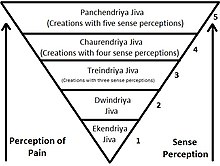
The food choices of Jains are based on the value of ahimsa (non-violence), and this makes the Jains to prefer food that inflict the to the lowest degree corporeality of violence
Vegetarianism in Jainism is based on the principle of nonviolence (ahimsa, literally "not-injuring"). Vegetarianism is considered mandatory for everyone. Jains are either lacto-vegetarians or vegans.[10] No use or consumption of products obtained from dead animals is allowed. Moreover, Jains attempt to avoid unnecessary injury to plants and suksma jiva (Sanskrit for 'subtle life forms'; minuscule organisms). The goal is to cause as piffling violence to living things as possible, hence they avoid eating roots, tubers such every bit potatoes, garlic and anything that involves uprooting (and thus eventually killing) a plant to obtain food.
Every act past which a person straight or indirectly supports killing or injury is seen as violence (hinsa), which creates harmful karma. The aim of ahimsa is to forestall the aggregating of such karma.[11] Jains consider nonviolence to exist the near essential religious duty for everyone (ahinsā paramo dharmaḥ, a statement oftentimes inscribed on Jain temples). Their scrupulous and thorough way of applying nonviolence to everyday activities, and specially to food, shapes their entire lives and is the nearly meaning hallmark of Jain identity. A side result of this strict subject field is the exercise of asceticism,[12] which is strongly encouraged in Jainism for lay people besides every bit for monks and nuns.
Jains do not practice animal sacrifice as they consider all sentient beings to be equal.
Hinduism [edit]
Hinduism has a wide diverseness of practices and behavior that accept changed over fourth dimension.[13] But some sects of Hindus observe vegetarianism,[14] an estimated 33% of all Hindus are vegetarians.[xv] [sixteen]
Nonviolence [edit]

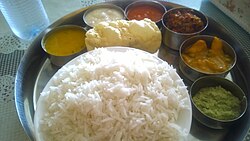
The principle of nonviolence (ahimsa) applied to animals is connected with the intention to avoid negative karmic influences which event from violence. The suffering of all beings is believed to arise from craving and desire, conditioned by the karmic effects of both fauna and human action. The violence of slaughtering animals for food, and its source in peckish, reveal flesh eating as one way in which humans enslave themselves to suffering.[17] Hinduism holds that such influences affect the person who permits the slaughter of an animal, the person who kills information technology, the person who cuts it up, the person who buys or sells meat, the person who cooks it, the person who serves it upwards, and the person who eats information technology. They must all be considered the slayers of the beast.[17] The question of religious duties towards the animals and of negative karma incurred from violence (himsa) against them is discussed in item in Hindu scriptures and religious law books.
Hindu scriptures belong or refer to the Vedic catamenia which lasted till about 500 BCE according to the chronological partition past mod historians. In the historical Vedic religion, the predecessor of Hinduism, meat eating was not banned in principle, but was restricted by specific rules. Several highly administrative scriptures bar violence against domestic animals except in the instance of ritual sacrifice. This view is clearly expressed in the Mahabharata (3.199.eleven–12;[18] 13.115; 13.116.26; xiii.148.17), the Bhagavata Purana (11.5.13–xiv), and the Chandogya Upanishad (8.fifteen.1). For case, many Hindus point to the Mahabharata's maxim that "Nonviolence is the highest duty and the highest teaching,"[nineteen] equally advocating a vegetarian diet. The Mahabharata also states that adharma (sin) was built-in when creatures started to devour ane some other from want of food and that adharma e'er destroys every animal "[xx] It is likewise reflected in the Manu Smriti (v.27–44), a traditional Hindu constabulary book (Dharmaśāstra). These texts strongly condemn the slaughter of animals and meat eating.
The Mahabharata (12.260;[21] thirteen.115–116; xiv.28) and the Manu Smriti (v.27–55) incorporate lengthy discussions nigh the legitimacy of ritual slaughter and subsequent consumption of the meat. In the Mahabharata both meat eaters and vegetarians present various arguments to substantiate their viewpoints. Apart from the debates near domestic animals, there is also a long discourse past a hunter in defence of hunting and meat eating.[22] These texts bear witness that both ritual slaughter and hunting were challenged past advocates of universal non-violence and their acceptability was doubtful and a affair of dispute.[23]
Lingayats are strict vegetarians. Devout Lingayats do non swallow beefiness, or meat of whatsoever kind including fish.[24]
Modern solar day [edit]
In modern India, the food habits of Hindus vary according to their community or caste and according to regional traditions. Hindu vegetarians usually eschew eggs but consume milk and dairy products, so they are lacto-vegetarians.
According to a survey of 2006, vegetarianism is weak in coastal states and strong in landlocked northern and western states and amongst Brahmins in full general, 85% of whom are lacto-vegetarians.[25] In 2018, a study from Economic and Political Weekly showed that as few as one 3rd of upper-caste Indians could be vegetarian.[26]
Many coastal inhabitants are fish eaters. In particular, Bengali Hindus have romanticized fishermen and the consumption of fish through poetry, literature, and music.
Hindus who eat meat are encouraged to eat Jhatka meat.[27] [28]
Creature sacrifice in Hinduism [edit]
Brute sacrifice in Hinduism[29] (sometimes known as Jhatka Bali) is the ritual killing of an animal in Hinduism.
The ritual sacrifice normally forms part of a festival to honour a Hindu god. For example, in Nepal the Hindu goddess Gadhimai,[30] is honoured every v years with the slaughter of 250,000 animals. This practice was banned from 2015.[31] Bali sacrifice today is mutual at the Sakta shrines of the Goddess Kali. Nevertheless, animal sacrifice is illegal in India.[32]
Buddhism [edit]
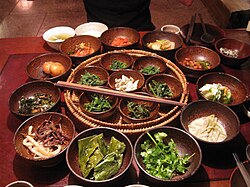
Buddhist influenced Korean vegetarian side dishes.
The Showtime Axiom prohibits Buddhists from killing people or animals.[33] The matter of whether this forbids Buddhists from eating meat has long been a matter of debate, however, as vegetarianism is not a given in all schools of Buddhism.
The commencement Buddhist monks and nuns were forbidden from growing, storing, or cooking their own nutrient. They relied entirely on the generosity of alms to feed themselves, and were not allowed to accept money to buy their own nutrient.[34] [35] They could not make special dietary requests, and had to have whatsoever food alms givers had available, including meat.[34] Monks and nuns of the Theravada school of Buddhism, which predominates in Sri Lanka, Thailand, Kingdom of cambodia, Burma, and Laos, still follow these strictures today.
These strictures were relaxed in Red china, Korea, Nihon, and other countries that follow Mahayana Buddhism, where monasteries were in remote mountain areas and the distance to the nearest towns fabricated daily alms rounds impractical. There, Buddhist monks and nuns could cultivate their ain crops, shop their ain harvests, cook their own meals, and accept money to buy foodstuffs in the marketplace.
Co-ordinate to the Vinaya Pitaka, when Devadatta urged the Buddha to brand complete forbearance from meat compulsory, the Buddha refused, maintaining that "monks would have to accept any they found in their begging bowls, including meat, provided that they had non seen, had non heard, and had no reason to suspect that the creature had been killed so that the meat could exist given to them".[36] There were prohibitions on specific kinds of meat: meat from humans, meat from royal animals such as elephants or horses, meat from dogs, and meat from dangerous animals like snakes, lions, tigers, panthers, bears and hyenas.[34]
On the other hand, certain Mahayana sutras strongly denounce the eating of meat. Co-ordinate to the Mahayana Mahaparinirvana Sutra, the Buddha revoked this permission to eat meat and warned of a Dark Historic period when false monks would claim that they were allowed meat.[35] In the Lankavatara Sutra, a disciple of the Buddha named Mahamati asks "[Y]ou teach a doctrine that is flavoured with compassion. It is the education of the perfect Buddhas. And yet we eat meat withal; we have not put an end to it."[37] An unabridged chapter is devoted to the Buddha's response, wherein he lists a litany of spiritual, physical, mental, and emotional reasons why meat eating should be abjured.[38] However, according to Suzuki (2004:211) harvcoltxt error: no target: CITEREFSuzuki2004 (help), this affiliate on meat eating is a "later addition to the text....Information technology is quite probable that meat-eating was practiced more or less amongst the earlier Buddhists, which was made a field of study of astringent criticism by their opponents. The Buddhists at the fourth dimension of the Laṅkāvatāra did not like it, hence this addition in which an apologetic tone is noticeable."[39] Phelps (2004:64–65) points to a passage in the Surangama Sutra which implies advocacy of "non but a vegetarian, but a vegan lifestyle"; however, numerous scholars over the centuries have concluded that the Śūraṅgama Sūtra is a forgery.[forty] [41] Moreover, in the Mahayana Mahaparinirvana Sutra, the same sutra which records his retraction of permission to eat meat, the Buddha explicitly identifies equally "beautiful foods" honey, milk, and cream, all of which are eschewed past vegans.[35] Nevertheless, in several other Mahayana scriptures, also (e.g., the Mahayana jatakas), the Buddha is seen clearly to betoken that meat-eating is undesirable and karmically unwholesome.
Some suggest that the rise of monasteries in Mahayana tradition to exist a contributing factor in the emphasis on vegetarianism. In the monastery, food was prepared specifically for monks. In this context, large quantities of meat would take been specifically prepared (killed) for monks. Henceforth, when monks from the Indian geographical sphere of influence migrated to China from the year 65 CE on, they met followers who provided them with money instead of food. From those days onwards Chinese monastics, and others who came to inhabit northern countries, cultivated their own vegetable plots and bought food in the market.[vii][8] This remains the dominant practise in China, Vietnam, and part of Korean Mahayanan temples.
Mahayana lay Buddhists often consume vegetarian diets on the vegetarian dates (齋期). There are different arrangement of the dates, from several days to iii months in each year, in some traditions, the celebration of the bodhisattva Avalokitesvara'south birthday, enlightenment and leaving abode days concord the highest importance to be vegetarian.
In China, Korea, Vietnam, Taiwan, and their respective diaspora communities, monks and nuns are expected to abstain from meat and, traditionally, eggs and dairy, in addition to the fetid vegetables – traditionally garlic, Allium chinense, asafoetida, shallot, and Allium victorialis (victory onion or mountain leek), although in modern times this rule is often interpreted to include other vegetables of the onion genus, every bit well as coriander – this is called pure vegetarianism or veganism (純素, chúnsù). Pure vegetarianism or veganism is Indic in origin and is still practiced in India by some adherents of Dharmic religions such as Jainism and in the case of Hinduism, lacto-vegetarianism with the additional avoidance of pungent or fetid vegetables.
In the modernistic Buddhist globe, attitudes toward vegetarianism vary past location. In China and Vietnam, monks typically eat no meat, with other restrictions as well. In Japan or Korea, some schools exercise not eat meat, while virtually do. Theravadins in Sri Lanka and Southeast Asia practise not practice vegetarianism. All Buddhists, including monks, are allowed to exercise vegetarianism if they wish to exercise so. Phelps (2004:147) states that "There are no accurate statistics, simply I would estimate—and it is only a approximate—that worldwide about half of all Buddhists are vegetarian".
Sikhism [edit]
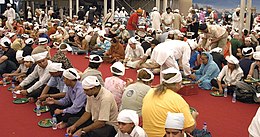
At the Sikh langar, all people eat a vegetarian meal equally equals.
Some followers of Sikhism do not have a preference for meat or vegetarian consumption.[42] [43] [44] [45] However the indian state of Punjab, homeplace for near Sikhs, has the 3rd highest percent of vegetarians out of all 29 indian states. In that location are two views on initiated or "Amritdhari Sikhs" and meat consumption. "Amritdhari" Sikhs (i.e., those who follow the Sikh Rehat Maryada, the Official Sikh Lawmaking of Conduct[46]) tin can consume meat (provided it is not Kutha meat). "Amritdharis" who belong to some Sikh sects (due east.k., Akhand Kirtani Jatha, Damdami Taksal, Namdhari,[47] Rarionwalay,[48] etc.) are vehemently against the consumption of meat and eggs.[49]
In the case of meat, the Sikh gurus have indicated their preference for a simple diet,[50] which could include meat or not. Passages from the Guru Granth Sahib (the holy volume of Sikhs, also known as the Adi Granth) say that fools argue over this outcome. Guru Nanak said that overconsumption of food (Lobh, 'greed') involves a drain on the World'due south resource and thus on life.[51] The tenth guru, Guru Gobind Singh, prohibited the Sikhs from the consumption of halal or Kutha (whatever ritually slaughtered meat) meat considering of the Sikh belief that sacrificing an brute in the name of God is mere ritualism (something to be avoided).[42]
Guru Nanak states that all living beings are connected. Fifty-fifty meat comes from the consumption of vegetables, and all forms of life are based on water.[52]
O Pandit, you lot exercise not know where did flesh originate! Information technology is water where life originated and information technology is h2o that sustains all life. It is water that produces grains, sugarcane, cotton and all forms of life.
Sikhs who consume meat eat Jhatka meat.
Abrahamic religions [edit]
Judaic, Christian, and Muslim traditions (Abrahamic religions) all take strong connections to the Biblical ideal of the Garden of Eden,[53] which includes references to a herbivore nutrition.[Genesis 1:29–31, Isaiah 11:6–9] While vegetarianism has not traditionally been viewed as mainstream in these traditions, some Jews, Christians, and Muslims practice and advocate vegetarianism.
Judaism [edit]
Though Jewish vegetarianism is not frequently viewed as mainstream, a number of Jews have argued for Jewish vegetarianism. Medieval rabbis such as Joseph Albo and Isaac Arama regarded vegetarianism every bit a moral ideal,[54] and a number of mod Jewish groups and Jewish religious and cultural government have promoted vegetarianism. Groups advocating for Jewish vegetarianism include Jewish Veg, a gimmicky grassroots organization promoting veganism equally "God'south ideal diet",[55] and the Shamayim 5'Aretz Institute, which promotes a vegan diet in the Jewish customs through animal welfare activism, kosher veganism, and Jewish spirituality.[56] One source of advocacy for Jewish vegetarianism in State of israel is Amirim, a vegetarian moshav (village).[57]
Jewish Veg has named 75 gimmicky rabbis who encourage veganism for all Jews, including Jonathan Wittenberg, Daniel Sperber, David Wolpe, Nathan Lopes Cardozo, Kerry Olitzky, Shmuly Yanklowitz, Aryeh Cohen, Geoffrey Claussen, Rami M. Shapiro, David Rosen, Raysh Weiss, Elyse Goldstein, Shefa Gold, and Yonassan Gershom.[58] [59] Other rabbis who take promoted vegetarianism have included David Cohen, Shlomo Goren, Irving Greenberg, Asa Keisar, Jonathan Sacks, She'ar Yashuv Cohen, and Yitzhak HaLevi Herzog. Other notable advocates of Jewish vegetarianism include Franz Kafka, Roberta Kalechofsky, Richard H. Schwartz, Isaac Bashevis Vocaliser, Jonathan Safran Foer, and Aaron Due south. Gross.
Jewish vegetarians often cite Jewish principles regarding animal welfare, environmental ideals, moral character, and health as reasons for adopting a vegetarian or vegan diet.[lx] Some Jews point to legal principles including Bal tashkhit (the police which prohibits waste product) and Tza'ar ba'alei hayyim (the injunction not to cause 'hurting to living creatures').[61] Many Jewish vegetarians are particularly concerned about cruel practices in manufactory farms and high-speed, mechanized slaughterhouses.[60] Jonathan Safran Foer has raised these concerns in the brusk documentary film If This Is Kosher..., responding to what he considers abuses within the kosher meat industry.[62]
Some Jewish vegetarians have pointed out that Adam and Eve were not allowed to eat meat. Genesis 1:29 states "And God said: Behold, I have given you every herb yielding seed which is upon the face of all the earth, and every tree that has seed-yielding fruit—to you it shall be for food," indicating that God's original plan was for flesh to be vegan.[63]· Co-ordinate to some opinions, the whole world will again be vegetarian in the Messianic era, and not eating meat brings the world closer to that ideal.[63] Equally the platonic images of the Torah are vegetarian, i may see the laws of kashrut as actually designed to wean Jews away from meat eating and to move them toward the vegetarian ideal.[61]
Christianity [edit]

Within Eastern Christianity, vegetarianism is proficient as role of fasting during the Great Lent (although shellfish and other not-vertebrate products are generally considered acceptable during some periods of this time); vegan fasting is particularly mutual in Eastern Orthodoxy and Oriental Orthodox Churches, such as the Coptic Orthodox Church building of Alexandria, which generally fasts 210 days out of the year. This tradition greatly influenced the cuisine of Ethiopia.
Some Christian groups, such as Seventh-day Adventists, the Christian Vegetarian Association and Christian anarchists, accept a literal interpretation of the Biblical prophecies of universal vegetarianism (or veganism)[Genesis ane:29–1:31, Isaiah 11:6–xi:nine, Isaiah 65:25] and encourage these practices as preferred lifestyles or as a tool to turn down the commodity status of animals and the use of animal products for any purpose, although some of them say it is not required. Other groups betoken instead to allegedly explicit prophecies of temple sacrifices in the Messianic Kingdom, e.g. Ezekiel 46:12, where so-called peace offerings and then-called freewill offerings are said that volition be offered, and Leviticus 7:fifteen–twenty where it states that such offerings are eaten, what may contradict the very purpose of Jesus' purportedly sufficient amende.
Several Christian monastic groups, including the Desert Fathers, Trappists, Benedictines, Cistercians and Carthusians, all of the Orthodox monks and also Christian esoteric groups, such every bit the Rosicrucian Fellowship, accept encouraged pescatarianism.[64] [65]
The Bible Christian Church, a Christian vegetarian sect founded by Reverend William Cowherd in 1809, were i of the philosophical forerunners of the Vegetarian Club.[66] [67] Cowherd encouraged members to abstain from eating of meat every bit a form of temperance.[68]
Some Christian vegetarians, such as Keith Akers, fence that Jesus himself was a vegetarian.[69] Akers argues that Jesus was influenced by the Essenes, an ascetic Jewish sect. The present bookish consensus is that Jesus was non an Essene.[70] At that place is no historical record of Jesus' precise attitudes to animals, but there is a strand in his ethical education about the primacy of mercy to the weak, the powerless and the oppressed, which Walters and Portmess fence can also refer to captive animals.[17]
Other, more recent Christians movements, such every bit Sarx and CreatureKind, practice not maintain that Jesus himself was a vegetarian, but instead fence that many practices which occur in the gimmicky industrialized farming system, such as the mass alternative of 24-hour interval-old male-chicks in the egg industry, are incompatible with the life of peace and dearest to which Jesus called his followers.
Islam [edit]
Islam explicitly prohibits eating of some kinds of meat, especially pork. Nevertheless, 1 of the nearly important Islamic celebrations, Eid al-Adha, involves animal sacrifices (Udhiya). Muslims who can afford to do so cede domestic animals (ordinarily sheep, but also camels, cows, and goats). According to the Quran,[71] a large portion of the meat has to be given towards the poor and hungry, and every try is to be fabricated to see that no impoverished Muslim is left without sacrificial food during the days of feasts like Eid-ul-Adha.[72] On the other hand, Udhiya is only a sunnah and is not obligatory: even caliphs have used not-beast means of sacrifice for Eid.[73]
Certain Islamic orders are mainly vegetarian; many Sufis maintain a vegetarian diet.[74] Some Muslims in Indonesia call up that being a vegetarian for reasons other than health is un-Islamic and it is a form of emulation of the infidels (tashabbuh bil kuffar).[75] On the other manus, the Rishi order in Kashmir were historically described as abstaining from meat consumption.[76]
The prophet Muhammad, however, was strongly against the frequent consumption of meat and, for his part, was said to subsist mainly on a diet of dates and barley.[77] [78]
Sri Lankan Sufi main Bawa Muhaiyaddeen, who established The Bawa Muhaiyaddeen Fellowship of North America in Philadelphia. The former Indian president Dr. A. P. J. Abdul Kalam was likewise famously a vegetarian.[79] [80]
In January 1996, The International Vegetarian Spousal relationship announced the germination of the Muslim Vegetarian/Vegan Society.[81] There is also a Vegan Muslim Initiative, founded 2017. They encourage Muslims to try a vegan diet during Ramadan, making information technology a "Veganadan".[82]
Proponents of vegetarianism in Islam have pointed to the teachings in the Quran and the Hadith which instruct kindness and pity towards animals as well as avoiding backlog:
"Transgress not in the balance, and weigh with justice, and skimp not in the balance...earth, He ready it downwardly for all beings"
– Surrah Ar-Rahman 55:8–10[83]
"Whoever is kind to the creatures of God is kind to himself."
– Hadith: Bukhari[83] [84]"A skillful human action done to an animate being is as meritorious as a expert deed washed to a human being, while an act of cruelty to an animal is as bad as an act of cruelty to a human being."
– Hadith: Mishkat al-Masabih; Volume six; Affiliate 7, 8:178[83]"O sons of wisdom, practice not turn your stomachs into graveyards for animals."
– Hadith: Fayd al-Qadīr Sharh al-Jami' as-Saghīr 2/52[82]"Beware of meat, for meat can be as addictive as wine"
– Hadith: al-Muwaṭṭa' 1742[82]
Rastafari [edit]
Rastafari by and large follow a diet called "I-tal", which eschews the eating of nutrient that has been artificially preserved, flavoured, or chemically altered in whatever way. Some Rastafari consider information technology to also forbid the eating of meat simply the bulk volition not consume pork at the very least, considering it unclean.
Baháʼí Faith [edit]
While there are no dietary restrictions in the Baháʼí Faith, 'Abdu'fifty-Bahá, the son of the founder of the religion, noted that a vegetarian nutrition consisting of fruits and grains was desirable, except for people with a weak constitution or those that are sick.[85] He stated that at that place are no requirements that Baháʼís become vegetarian, simply that a future lodge would gradually get vegetarian.[85] [86] [87] 'Abdu'l-Bahá also stated that killing animals was somewhat contrary to pity.[85] While Shoghi Effendi, the head of the Baháʼí Organized religion in the first half of the 20th century, stated that a purely vegetarian diet would be preferable since it avoided killing animals,[88] both he and the Universal Business firm of Justice (the governing trunk of the Baháʼís) have stated that these teachings do not constitute a Baháʼí practice and that Baháʼís tin choose to eat any they wish, only to be respectful of others' beliefs.[85]
Other religions [edit]
Manichaeism [edit]
Manichaeism was a organized religion established by the Iranian named Mani during the Sassanian Empire. The religion prohibited slaughtering or eating animals.[89]
Zoroastrianism [edit]
Mazdakism, a sect of Zoroastrianism, explicitly promoted vegetarianism.[90]
One of the primary precepts in Zoroastrianism is respect and kindness towards all living things and condemnation of cruelty against animals.[ citation needed ]
The Shahnameh states that the evil rex of Persia, Zohak, was first taught eating meat by the evil one who came to him in the guise of a cook. This was the start of an age of keen evil for Persia. Prior to this, in the Golden age of mankind in the days of the bang-up Aryan Kings, man did non eat meat.
The Pahlavi scriptures state that in the final stages of the world, when the terminal Saviour Saoshyant arrives, human being volition become more spiritual and gradually give up meat eating.
Vegetarianism is stated to exist the future state of the world in Pahlavi scriptures – Atrupat-e Emetan in Islamic republic of iran in Denkard Book VI requested all Zoroastrians to be vegetarians:
"ku.san enez a-on ku urwar xwarishn bawed shmah mardoman ku derziwishn bawed, ud az tan i gospand pahrezed, ce amar was, e.m. Ohrmaz i xwaday hay.yarih i gospand ray urwar was dad."
Pregnant: They agree this also: Be plant eaters (urwar xwarishn) (i.e. vegetarian), O you, men, so that y'all may live long. Go along away from the body of cattle (tan i gospand), and deeply reckon that Ohrmazd, the Lord has created plants in great number for helping cattle (and men)."
Nation of Islam [edit]
The Nation of Islam promotes vegetarianism deeming it the "about healthful and virtuous fashion to eat".[91]
Taoism [edit]
In Chinese societies, "elementary eating" (素食 Mandarin: sù shí) refers to a detail restricted diet associated with Taoist monks, and sometimes practiced by members of the general population during Taoist festivals and fasting days. It is similar to Chinese Buddhist vegetarianism. Varying levels of abstinence among Taoists and Taoist-influenced people include veganism, veganism without root vegetables, lacto-ovo vegetarianism, and pescetarianism. Taoist vegetarians also tend to abjure from alcohol and pungent vegetables such as garlic and onions during lenten days. Non-vegetarian Taoists sometimes abstain from beef and h2o buffalo meat for many cultural reasons.
Vegetarianism in the Taoist tradition is like to that of Lent in the Christian tradition. While highly religious people such every bit monks may exist vegetarian, vegan or pescetarian on a permanent basis, lay practitioners often eat vegetarian on the 1st (new moon), 8th, 14th, 18th, 23rd, 24th, 28th, 29th and 30th days of the lunar calendar. In accordance with their Buddhist peers, and considering many people are both Taoist and Buddhist, they often also eat lenten on the 15th 24-hour interval (full moon). Taoist vegetarianism is similar to Chinese Buddhist vegetarianism, however, its roots reach to pre-Buddhist times. Believers historically abstained from animal products and alcohol before practicing Confucian, Taoist and Chinese folk religion rites.[ citation needed ]
It is referred to by the English word "vegetarian"; however, though it rejects meat, eggs, and milk, this nutrition may include oysters and oyster products or otherwise be pescetarian for some believers. Many lay Taoists who follow modernistic sects such as that of Yi Guan Dao or Master Ching Hai are vegan or strictly vegetarian.[ citation needed ]
Faithist/Oahspe [edit]
Oahspe (Meaning Sky, Globe and Spirit) is the doctrinal book of those who follow Faithism. The precepts for behavior tin can be constitute throughout the book which include" a herbivorous nutrition (vegan, vegetable food only), peaceful living (no warring or violence; pacifism), living a life of virtue, service to others, celestial assistance, spiritual communion, and communal living when it is feasible to do so. Liberty and responsibility are two themes reiterated throughout the text of Oahspe.
Neopaganism [edit]
There is no set educational activity on vegetarianism within the various neopagan communities, however many do follow a vegetarian nutrition often connected to ecological concerns besides equally the welfare and rights of animals. Vegetarian practitioners of Wicca volition often see their standpoint as a natural extension of the Wiccan Rede. Organizations like SERV refer to the historic figures of Porphyry, Pythagoras and Iamblichus as sources for the Infidel view of vegetarianism.[92] During the 1970s the publication Globe Religion News, focused on articles related to neopaganism and vegetarianism, it was edited past the author Herman Slater.[93]
Meher Baba's teachings [edit]
The spiritual teacher Meher Baba recommended a vegetarian nutrition for his followers[94] because he held that information technology helps one to avoid certain impurities: "Killing an brute for sport, pleasance or food means catching all its bad impressions, since the motive is selfish....Impressions are contagious. Eating meat is prohibited in many spiritual disciplines considering therein the person catches the impressions of the fauna, thus rendering himself more susceptible to animalism and anger."[95]
Creativity movement [edit]
The Creativity religion promotes[96] [97] [98] [99] a class of fruitinarian raw food nutrition in its "Salubrious Living" health plan named after the third text of the faith written by Arnold DeVries and Ben Klassen, which encourages the consumption of only raw foods in their "natural state, basically fruits, vegetables, grains and nuts,"[100] getting plenty of physical exercise as well every bit abstinence from alcohol, nicotine, caffeine, sugar, preservatives, insecticides, narcotics and other drugs whether prescription or non-prescription.[101] Healthy Living is considered mandatory to "fully exercise" Creativity and a lawsuit is currently in place against the Bureau of Prisons to get it recognized every bit a religious dietary preference[102] for incarcerated adherents of the religious motility.
Come across also [edit]
- Animal cede
- Fauna chaplains
- Environmental vegetarianism
- Ethics of eating meat
- Fasting
- History of vegetarianism
- Vegetarian cuisine
- Vegetarian nutrition
References [edit]
- ^ Tähtinen, Unto (1976). Ahimsa: Not-Violence in Indian Tradition. London. pp. 107–111.
- ^ Walters, Kerry S.; Lisa Portmess (2001). Religious Vegetarianism From Hesiod to the Dalai Lama. Albany. pp. 37–91.
- ^ "What Exercise Yous Know of the Akhand Kirtani Jatha?". Sikhism 101. UniversalFaith.net. Archived from the original on 5 January 2009. Retrieved xiii July 2010.
- ^ "Sikhism: A Universal Message". thirteen March 2009. Archived from the original on 13 July 2012. Retrieved seven January 2009.
- ^ Walters, Kerry S.; Lisa Portmess (2001). Religious Vegetarianism From Hesiod to the Dalai Lama. Albany. pp. 123–167.
- ^ Iacobbo, Karen; Michael Iacobbo (2004). Vegetarian America. A History . Westport. pp. 3–xiv, 97–99, 232–233.
- ^ Faxian (1886). "On To Mathura Or Muttra. Condition And Customs Of Central Republic of india; Of The Monks, Viharas, And Monasteries.". A Record of Buddhistic Kingdoms. Translated by Legge, James.
- ^ Bodhipaksa (2016). Vegetarianism. Windhorse. ISBN978-19093-14-740.
- ^ Nelson, Dean (20 November 2009). "India tells West to terminate eating beef". The Daily Telegraph. London. Archived from the original on 13 October 2018. Retrieved 4 April 2018.
- ^ "Dietary code of practice amongst Jains". International Vegetarian Matrimony (IVU). Archived from the original on nine January 2016. Retrieved 28 Apr 2015.
- ^ Laidlaw, James: Riches and Renunciation. Organized religion, economic system, and society amidst the Jains, Oxford 1995, p. 26–thirty, 191–195.
- ^ Disclaimer: "The pregnant of divineness discourses is complex." The word, however, is frequently used in a derogatory style against the veg(etari)an motion. Characterizing veganism as asceticism, pp. 141–142. In: Matthew Cole, Karen Morgan (2011). "Vegaphobia: derogatory discourses of veganism and the reproduction of speciesism in UK national newspapers". The British Journal of Sociology. 62 (ane): 134–153. doi:10.1111/j.1468-4446.2010.01348.x. PMID 21361905.
{{cite journal}}: CS1 maint: uses authors parameter (link) - ^ Klostermaier, Klaus 1000. (1994). A survey of Hinduism (Edition: 2 ed.). SUNY Press. p. 165. ISBN978-0-7914-2109-three.
- ^ Antoine Dubois, Jean; Carrie Chapman Catt (2002). Hindu Manners, Customs and Ceremonies: The Classic Beginning Hand Business relationship of India in the Early Nineteenth Century. Henry K. Beauchamp. Courier Dover Publications. p. 110. ISBN978-0-486-42115-5.
- ^ Schmidt, Arno; Fieldhouse, Paul (2007). The globe religions cookbook. Greenwood Publishing Grouping. p. 99. ISBN978-0-313-33504-4.
- ^ Badlani, Dr. Hiro One thousand. (23 September 2008). "48". HINDUISM PATH OF THE ANCIENT WISDOM. Global Authors Publishers. p. 260. ISBN978-0-595-70183-4 . Retrieved xiii June 2010.
- ^ a b c Walters, Kerry S. and Portmess, Lisa. Religious Vegetarianism: From Hesiod to the Dalai Lama. State University of New York Printing. New York, 2001. pp. 41, 42, 61, 62, 187, 191. ISBN 0-7914-4972-6.
- ^ Mahabharata iii.199 is 3.207 according to some other count.
- ^ Mahabharata 13.116.37–41
- ^ Mahabharata section LXVI"
- ^ Mahabharata 12.260 Archived 10 September 2007 at the Wayback Motorcar. Mahabharata 12.260 southward 12.268 according to another count.
- ^ Mahabharata 3.199 Archived 29 September 2007 at the Wayback Car. Mahabharata 3.199 is iii.207 according to another count.
- ^ Alsdorf pp. 572–577 (for the Manu Smriti) and pp. 585–597 (for the Mahabharata).
- ^ Ishwaran 1983, p. 119–120. sfn error: no target: CITEREFIshwaran1983 (aid)
- ^ Yadav, Y.; Kumar, Due south (xiv August 2006). "The food habits of a nation". The Hindu. Archived from the original on 29 October 2006. Retrieved 17 Nov 2006.
- ^ Biswas, Soutik (4 April 2018). "The myth of the Indian vegetarian nation". BBC News. Archived from the original on viii August 2018. Retrieved 21 July 2018.
- ^ "The Hindu – Changes in the Indian menu over the ages". Archived from the original on 26 August 2010. Retrieved 2 Jan 2010.
{{cite spider web}}: CS1 maint: unfit URL (link) - ^ Das, Veena (thirteen Feb 2003). The Oxford Republic of india companion to sociology and social anthropology, Volume 1. Vol. 1. OUP India. p. 151. ISBN978-0-xix-564582-viii.
- ^ O.P. Radhan (September 2002). Encyclopaedia of Political Parties. Vol. 33 to 50. Anmol, India. p. 854. ISBN978-81-7488-865-5.
- ^ Lang, Olivia (24 November 2009). "Hindu cede of 250,000 animals begins". The Guardian. Archived from the original on 8 September 2013. Retrieved 27 July 2010.
- ^ "Thousands of Animals Have Been Saved in Nepal as Mass Slaughter is Cancelled". 29 July 2015.
- ^ Julius J. Lipner (23 July 1998). "ix". Hindus: Their Religious Beliefs and Practices (Library of Religious Behavior and Practices) (Paper ed.). Routledge. p. 185. ISBN978-0-415-05182-8.
- ^ "Leading a Buddhist Life and the 5 Precepts". Archived from the original on 7 September 2008. Retrieved 26 July 2008.
- ^ a b c "What the Buddha Said Most Eating Meat". Archived from the original on 15 August 2008. Retrieved 26 July 2008.
- ^ a b c "Nirvana Sutra: Appreciation of the "Mahayana Mahaparinirvana Sutra"". Archived from the original on xvi February 2013. Retrieved 23 March 2013.
- ^ Phelps 2004:76
- ^ "Lankavatara Sutra – The Faults of Eating Meat". Archived from the original on 4 July 2008. Retrieved 26 July 2008.
- ^ Phelps 2004:61–63
- ^ Suzuki, D. T. (1999). The Laṅkāvatāra Sūtra: A Mahāyāna Text. Buddhist Tradition Series. Vol. 40. Delhi: Motilal Banarsidass. ISBN978-81-208-1655-8.
This chapter on meat-eating is another later add-on to the text, which was probably done earlier than the Rāvaṇa chapter. It already appears in the Sung, but of the iii Chinese versions it appears here in its shortest form, the proportion being South = i, T = 2, W = 3. It is quite probable that meat-eating was practised more or less among the before Buddhists, which was made a discipline of astringent criticism by their opponents. The Buddhists at the time of the Laṅkāvatāra did not like information technology, hence this add-on in which an apologetic tone is noticeable.
- ^ Hurvitz, Leon (May 1967). "The Surangama Sutra". Periodical of Asian Studies. 26 (3): 482–484. doi:10.2307/2051432. JSTOR 2051432. S2CID 164194704.
{{cite periodical}}: CS1 maint: date and yr (link) - ^ Faure, Bernard (1991). The Rhetoric of Immediacy. A Cultural Critique of Chan/Zen Buddhism. Princeton: Princeton University Press.
- ^ a b "Misconceptions Most Eating Meat – Comments of Sikh Scholars," Archived 28 Dec 2008 at the Wayback Machine at The Sikhism Home Folio Archived 17 January 2009 at the Wayback Machine
- ^ Sikhs and Sikhism, by I.J. Singh, Manohar, Delhi ISBN 978-81-7304-058-0: Throughout Sikh history, there accept been movements or subsects of Sikhism which have espoused vegetarianism. I recall at that place is no basis for such dogma or practice in Sikhism. Certainly Sikhs exercise not recall that a vegetarian's achievements in spirituality are easier or college. It is surprising to come across that vegetarianism is such an important facet of Hindu practice in light of the fact that beast sacrifice was a significant and much valued Hindu Vedic ritual for ages. Guru Nanak in his writings clearly rejected both sides of the arguments—on the virtues of vegetarianism or meat eating—as bland and so much nonsense, nor did he accept the thought that a cow was somehow more sacred than a horse or a craven. He besides refused to be fatigued into a contention on the differences between mankind and greens, for instance. History tells us that to impart this message, Nanak cooked meat at an important Hindu festival in Kurukshetra. Having cooked it he certainly did not waste matter information technology, but probably served information technology to his followers and ate himself. History is quite articulate that Guru Hargobind and Guru Gobind Singh were accomplished and avid hunters. The game was cooked and put to skillful use, to throw it away would have been an awful waste.
- ^ Guru Granth Sahib, An Analytical Study past Surindar Singh Kohli, Singh Bros. Amritsar ISBN 81-7205-060-7: The ideas of devotion and service in Vaishnavism take been accustomed by Adi Granth, but the insistence of Vaishnavas on vegetarian diet has been rejected.
- ^ A History of the Sikh People by Dr. Gopal Singh, World Sikh University Press, Delhi ISBN 978-81-7023-139-4: Withal, it is strange that now-a-days in the Community-Kitchen attached to the Sikh temples, and chosen the Guru'south Kitchen (or, Guru-ka-langar) meat-dishes are not served at all. May be, information technology is on account of its beingness, peradventure, expensive, or not easy to keep for long. Or, peradventure the Vaishnava tradition is too stiff to be shaken off.
- ^ "Sikh Reht Maryada, The Definition of Sikh, Sikh Conduct & Conventions, Sikh Religion Living, India". sgpc.net. Archived from the original on xx Baronial 2009. Retrieved 29 August 2009.
- ^ Vegetarianism and Meat-Eating in viii Religions Archived 26 September 2008 at the Wayback Machine April/May/June 2007 Hinduism Today
- ^ Philosophy of Sikhism past Gyani Sher Singh (PhD), Shiromani Gurdwara Parbandhak Committee. Amritsar: As a true Vaisnavite Kabir remained a strict vegetarian. Kabir far from defying Brahmanical tradition equally to the eating of meat, would not permit so much, as the plucking of a flower (Yard.M.Southward. p. 479), whereas Nanak accounted all such scruples to be superstitions, Kabir held the doctrine of Ahinsa or the not-devastation of life, which extended even to that of flowers. The Sikh Gurus, on the contrary, allowed and even encouraged, the use of beast flesh as nutrient. Nanak has exposed this Ahinsa superstition in Asa Ki War (Chiliad.M.S. p. 472) and Malar Ke War (Grand.G.S. p. 1288)
- ^ "Langar," Archived 2 May 2009 at the Wayback Automobile at http://www.sikhwomen.com Archived 27 October 2009 at the Wayback Machine
- ^ Singh, Prithi Pal (2006). "3 Guru Amar Das". The History of Sikh Gurus. New Delhi: Lotus Printing. p. 38. ISBN978-81-8382-075-2.
- ^ "The Sikhism Home Page". Sikhs.org. Archived from the original on 27 June 2009. Retrieved nine August 2009.
- ^ a b Clarke, Steve (2020). Religious Studies Route A: Religious, Philosophical and Ethical studies and Christianity, Buddhism, Hinduism and Sikhism. Hachette Uk. p. 117. ISBN9781510479531.
- ^ Eric Baratay, 50'anthropocentrisme du christianisme occidental, Si les lions pouvaient parler, essais sur la condition animale, sous la direction de Boris Cyrulnik, Gallimard, ISBN 2-07-073709-8
- ^ Rabbi J. David Bleich, https://web.archive.org/web/20120518014142/http://world wide web.innernet.org.il/article.php?assist=107, Reprinted with permission from "Contemporary Halakhic Bug, Volume III", KTAV Publishers.
- ^ "What'southward Jewish About Being Veg". Archived from the original on 6 March 2016. Retrieved two March 2016.
- ^ "The Shamayim V'Aretz Establish | מכון שמים וארץ". The Shamayim V'Aretz Constitute | מכון שמים וארץ. Archived from the original on 30 December 2018. Retrieved 27 March 2018.
- ^ "Ohn-Bar Guesthouse in Amirim – Well-nigh the hamlet and hikes". Archived from the original on 22 March 2018. Retrieved 22 March 2018.
- ^ "Rabbinic Statement". Archived from the original on 17 March 2018. Retrieved 2 March 2018.
- ^ "74 Rabbis Urge Jewish Customs to Get Vegan". VegNews.com. Archived from the original on 2 March 2018. Retrieved 27 March 2018.
- ^ a b Mary L. Zamore, ed. The Sacred Table: Creating a Jewish Nutrient Ethic (New York, NY: CCAR Press, 2011).
- ^ a b Kalechofsky, Roberta. Rabbis and Vegetarianism: An Evolving Tradition. Micah Publications. Massachusetts, 1995. pp. 16, 54, 55, 65, 66, 68, 70, 71. ISBN 0-916288-42-0.
- ^ Foer, Jonathan Safran. "If This Is Kosher…". Archived from the original on 27 May 2011. Retrieved 1 October 2012.
- ^ a b Schwartz, Richard H. Judaism and Vegetarianism. Lantern Books. New York, 2001. pp. 1, 12, 16, 19, 188. ISBN 1-930051-24-vii.
- ^ Article The Wisdom of the Vegetarian Diet Archived one October 2009 at the Wayback Machine by The Rosicrucian Fellowship (Esoteric Christians)
- ^ Max Heindel (1910s), New Age Vegetarian Cookbook, The Rosicrucian Fellowship (publisher), 492 pages
- ^ "The Bible Christian Church". International Vegetarian Union. Archived from the original on 5 May 2012.
- ^ "History of Vegetarianism – Early Ideas". The Vegetarian Society. Archived from the original on 16 July 2012. Retrieved 8 July 2008. ; Gregory, James (2007) Of Victorians and Vegetarians. London: I. B. Tauris pp. 30–35.
- ^ "William Cowherd (cursory information)". Oxford Dictionary of National Biography. Retrieved 8 July 2008.
- ^ Keith Akers. "Was Jesus a vegetarian?". Archived from the original on 27 October 2010. Retrieved 23 October 2010.
- ^ Young, Richard Alan. Is God a Vegetarian?. Carus Publishing Company. Chicago, 1999. pp. 4, vii, 56, 117. ISBN 0-8126-9393-0.
- ^ "Quran Surah Al-Hajj ( Verse 28 )". Archived from the original on 27 January 2018. Retrieved 26 January 2018.
- ^ "Quran Surah Al-Hajj ( Verse 36 )". Archived from the original on 27 January 2018. Retrieved 26 January 2018.
- ^ "If y'all are a vegetarian and an animal right activist are y'all even so required to follow the animal sacrifice ritual of Eid-al-Adha? If y'all do not does that brand you a bad muslim in whatsoever way? Plus are in that location alternative methods of showing your gratitude to God?". Ask the scholar, Islamic question and answer website of shaikh Ahmad kutty.
- ^ Arzenjani, Mohd. Almamoon (1957). "Sufism". 15th World Vegetarian Congress 1957. International Vegetarian Union. Archived from the original on 22 January 2009.
- ^ "Vegetarian Dalam Timbangan Islam". muslimah.or.id (in Indonesian). eight May 2008.
- ^ Qadri, Shafi (2002). Kashmiri Sufism. Srinagar: Gulshan Publishers. p. 75. ISBN81-86714-35-nine.
- ^ Sheikh, Rahil (fifteen January 2020). "Vegan and Muslim: Why I kept my plant-based diet surreptitious from my family". BBC. Retrieved 16 February 2021.
- ^ Mayton, Joseph (26 August 2010). "Eating less meat is more Islamic". The Guardian . Retrieved 16 February 2021.
- ^ "APJ Abdul Kalam's Death Anniversary: 10 Lesser Known Facts Most the 11th President of India". News18 . Retrieved 10 December 2019.
- ^ "lokpriya!". Lokpriya.com. Archived from the original on 21 March 2015. Retrieved 31 March 2015.
- ^ "IVU News – Islam and Vegetarianism". Ivu.org. Retrieved ix August 2009.
- ^ a b c "You are what you Eid: Ramadan for vegans". the Guardian. thirty May 2019. (Hadith identification by "AK")
- ^ a b c Rahman, S. A. (2017). "Religion and Animal Welfare—An Islamic Perspective". Animals. NCBI. 7 (2): eleven. doi:ten.3390/ani7020011. PMC5332932. PMID 28218670.
- ^ "Is the Meat Industry an Offense to Islam?". Animals in Islam.
- ^ a b c d Smith, Peter (2000). "Nutrition". A concise encyclopedia of the Baháʼí Organized religion. Oxford: Oneworld Publications. pp. 121–122. ISBN978-1-85168-184-six.
- ^ Esslemont, J.E. (1980). Bahá'u'lláh and the New Era (fifth ed.). Wilmette, Illinois, USA: Baháʼí Publishing Trust. ISBN978-0-87743-160-2. Archived from the original on 21 Jan 2012. Retrieved 25 May 2009.
- ^ 'Abdu'50-Bahá (1912). MacNutt (ed.). The Promulgation of Universal Peace. Wilmette, Illinois, Us: Baháʼí Publishing Trust (published 1982). ISBN978-0-87743-172-5. Archived from the original on 21 January 2012. Retrieved 25 May 2009.
- ^ The Inquiry Department of the Universal House of Justice. "Extracts from The Writings Concerning Health, Healing, and Diet". Archived from the original on 8 October 2010. Retrieved 25 May 2009.
- ^ "MANICHEISM i. Full general SURVEY – Encyclopaedia Iranica". Archived from the original on 31 March 2018. Retrieved 30 March 2018.
- ^ "Mazdak Mazdakism. Zoroastrian Sects". Archived from the original on 31 March 2018. Retrieved xxx March 2018.
- ^ "How to Consume to Live". Archived from the original on 4 December 2015. Retrieved 21 November 2015.
- ^ "Paganism and Native Religions". Archived from the original on 22 May 2006. Retrieved 9 April 2006.
- ^ "Archived copy". Archived from the original on 29 April 2006. Retrieved 9 April 2006.
{{cite spider web}}: CS1 maint: archived copy every bit title (link) - ^ "False Beliefs, Book Two: Meat Eating." Archived 3 October 2011 at the Wayback Machine Retrieved 5 July 2011.
- ^ Baba, Meher (1988). Sparks of the Truth: From the Dissertations of Meher Baba Archived 27 September 2011 at the Wayback Machine. Myrtle Beach: Sheriar Press. pp. 24–25. ISBN 0-913078-02-vi.
- ^ "Archived copy". Archived from the original on 13 October 2015. Retrieved 25 November 2015.
{{cite spider web}}: CS1 maint: archived copy every bit title (link) - ^ "Creativity Religion". Archived from the original on 27 November 2018. Retrieved 4 Feb 2019.
- ^ "Archived copy" (PDF). Archived (PDF) from the original on 26 October 2015. Retrieved 25 November 2015.
{{cite web}}: CS1 maint: archived copy as title (link) - ^ "Salubrious Living – Creativity Alliance". Archived from the original on xi February 2016. Retrieved 25 November 2015.
- ^ "Earth Church of the Creator".
- ^ Little White Book – 07 Three Brusk Rules for Maintaining Excellent Health
- ^ "Archived re-create" (PDF). Archived (PDF) from the original on 26 November 2015. Retrieved 25 November 2015.
{{cite web}}: CS1 maint: archived copy as title (link)
Further reading [edit]
- Religious Vegetarianism: From Hesiod to the Dalai Lama (2001) edited by: Kerry Walters; Lisa Portmess
- Lisa Kemmerer, Animals and Earth Religions (2012) ISBN 978-0199790685
- Phelps, Norm (2004). The Great Pity: Buddhism & Animal Rights. New York: Lantern Books. ISBN978-1590560693.
- Roberta Kalechofsky, Rabbis and Vegetarianism: An Evolving Tradition. (Micah Publications. Massachusetts, 1995. ISBN 0-916288-42-0.)
- Richard H. Schwartz, Judaism and Vegetarianism. (Lantern Books. New York, 2001. ISBN ane-930051-24-seven.)
- Richard Alan Young, Is God a Vegetarian? (Carus Publishing Company. Chicago, 1999. ISBN 0-8126-9393-0.)
- Rynn Berry, Food for the Gods: Vegetarianism & the World'due south Religions (Pythagorean Publishers. May 1998. 978-096261692.i)
- Steven J. Rosen, Diet for Transcendence (formerly published as Food for the Spirit): Vegetarianism and the Globe Religions, foreword by Isaac Bashevis Vocalist (Badger, California: Torchlight Books, 1997)
- Steven J. Rosen, Holy Moo-cow: The Hare Krishna Contribution to Vegetarianism and Creature Rights (New York: Lantern Books, 2004)
External links [edit]
- Buddhist Resources on Vegetarianism and Animal Welfare
- Rennets and religion The employ of rennet in Abrahamic religions
- The Fellowship of Life archive of British activism since the 1970s
- The Word of Wisdom: the Forgotten Verses A discussion of Latter-twenty-four hour period Saint (LDS or Mormon) beliefs and vegetarian principles
- What Gives Us the Right to Kill Animals? – A Jewish view on Vegetarianism chabad.org
- Fools Who Wrangle Over Flesh for a technical Sikh perspective
- Sikh History on Diet
Source: https://en.wikipedia.org/wiki/Vegetarianism_and_religion

Post a Comment for "Religious Group That Does Not Eat Beef"