Is Big Ag Making Money on Beef Sales
This is Office I of our series More than money: The cost of monopolies in America. Notice Function Ii here.
Corporate monopolies exercise a lot of ability in U.S. markets.
They boss many industries, including beefiness.
"You lot take cattle ranchers going bankrupt while consumers are paying best record prices for beef," Nib Bullard, caput of the Ranchers-Cattlemen Activity Legal Fund, says.
In ways you meet, and don't:
"It's failed consumers on one end of the supply chain, and it'south failed the American family farmer and rancher on the other," Bullard says.
Today, On Indicate: A discussion on monopolies and meat processing kicks off our special series More than money: The cost of monopolies in America.
Guests
Bill Bullard, head of Ranchers-Cattlemen Action Legal Fund, an advocacy group. His organization is a plaintiff in a class-action lawsuit that accuses meatpackers of manipulating prices.
Claire Kelloway, program manager for fair food and farming systems at the Open Markets Institute, a nonprofit anti-monopoly system. (@clairekelloway)
Jack Beatty, On Betoken news analyst. Author of the Age of Betrayal: The Triumph of Money in America and editor of Colossus: How the Corporation Changed America.(@JackBeattyNPR)
Also Featured
Jeanie Alderson, fourth generation rancher from Birney, Montana. Member of the Northern Plains Resource Council, a grassroots conservation and family agronomics group.
Sarah Little, spokeswoman for the North American Meat Institute, a Washington lobbying group representing packers and processors.
Aaron Metz, fourth generation rancher from the Badlands of Western North Dakota.
Show Transcript
Part I
MEGHNA CHAKRABARTI: In that location's a small Montana boondocks that's as small as information technology gets, population 110 to be exact. No stores or restaurants. The only business in town is the Post Office. But, it does take lots of grassland. And ...
JEANIE ALDERSON: In a state like Montana, in that location's more cows than people.
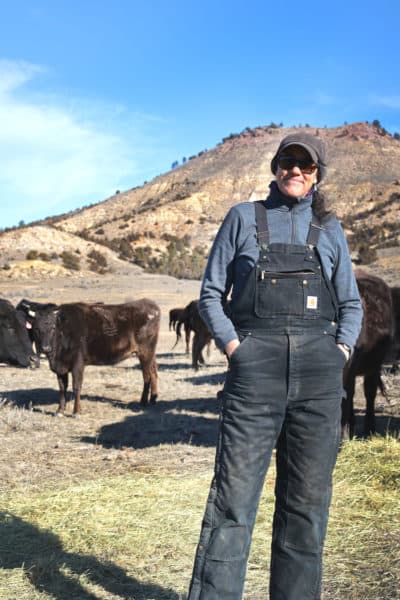
CHAKRABARTI: Jeanie Alderson is a fourth generation rancher. She grew up in that tiny town, Birney, in southeastern Montana.
ALDERSON: We're on our ranch today. Information technology'due south at the confluence of ii creeks, which is really special, that means we've got water. This is the high northern plains kind of terrain. Wonderful grasslands, simply information technology'south dry.
CHAKRABARTI: Jeanie'due south family unit has owned the Bones Brothers Ranch since 1889. More than 130 years.
ALDERSON: Ranching is what this community is, and it's who we are.
CHAKRABARTI: She's wondering, though, how long will it stay that way? Always since Jeanie took over the family business, she's seen things change, and rapidly.
ALDERSON: You know, when I was growing up, there were two lilliputian grocery stores in this town, and at present all you can purchase in Birney is a stamp.
CHAKRBARTI: This is On Signal. I'm Meghna Chakrabarti. Ranchers like Jeanie are so integral to the western U.s., they're indistinguishable from it. Just there are half a million fewer ranching families now. That's xl% less than there were in the 1980s. That's partly because of a long-term modify mostly hidden from public view in the structure of the beefiness industry. To consumers, it looks like a pretty open up market place. A lot of ranchers, selling a lot of beef, that ends up in a lot of grocery stores.
Simply the beef manufacture is really more like an hourglass. Between the ranchers and the shoppers there'south an atomic number 26 fist consolidating, and squeezing the meatpacking market place down to a virtual monopoly. That heavily influences prices paid to ranchers for their cattle. So more than than ever, ranchers like Jeanie Alderson are having a hard time hanging on.
ALDERSON: Agronomics has always been the hub, the center, the heart. And when you look around these little communities and you see all the boarded up businesses, yous realize that when ranching and farming are on hard times, information technology's hard on all the other businesses and all the communities around that.
CHAKRABARTI: All the communities around that. Well, for more 50 years, American antitrust regulation has followed a basic premise: Are consumers being harmed? Just now there's a new sheriff in town, and her name is Lina Khan. She'south the chair of the Federal Trade Committee, and Khan wants to rethink the entire definition of impairment when it comes to monopolies.
LINA KHAN [Record]: Monopolies are bad, not simply because they threaten to, you know, atomic number 82 to higher consumer prices or even necessarily undermine productivity and growth. But monopolies are bad because they're bad for democracy.
CHAKRABARTI: Today, we're launching a weeklong special serial called More coin: The cost of monopolies in America. And we'll exist exploring the idea of whether it'due south time to look more closely at what monopolistic consolidation does, not just to the markets those companies are in, just to the societies they're into.
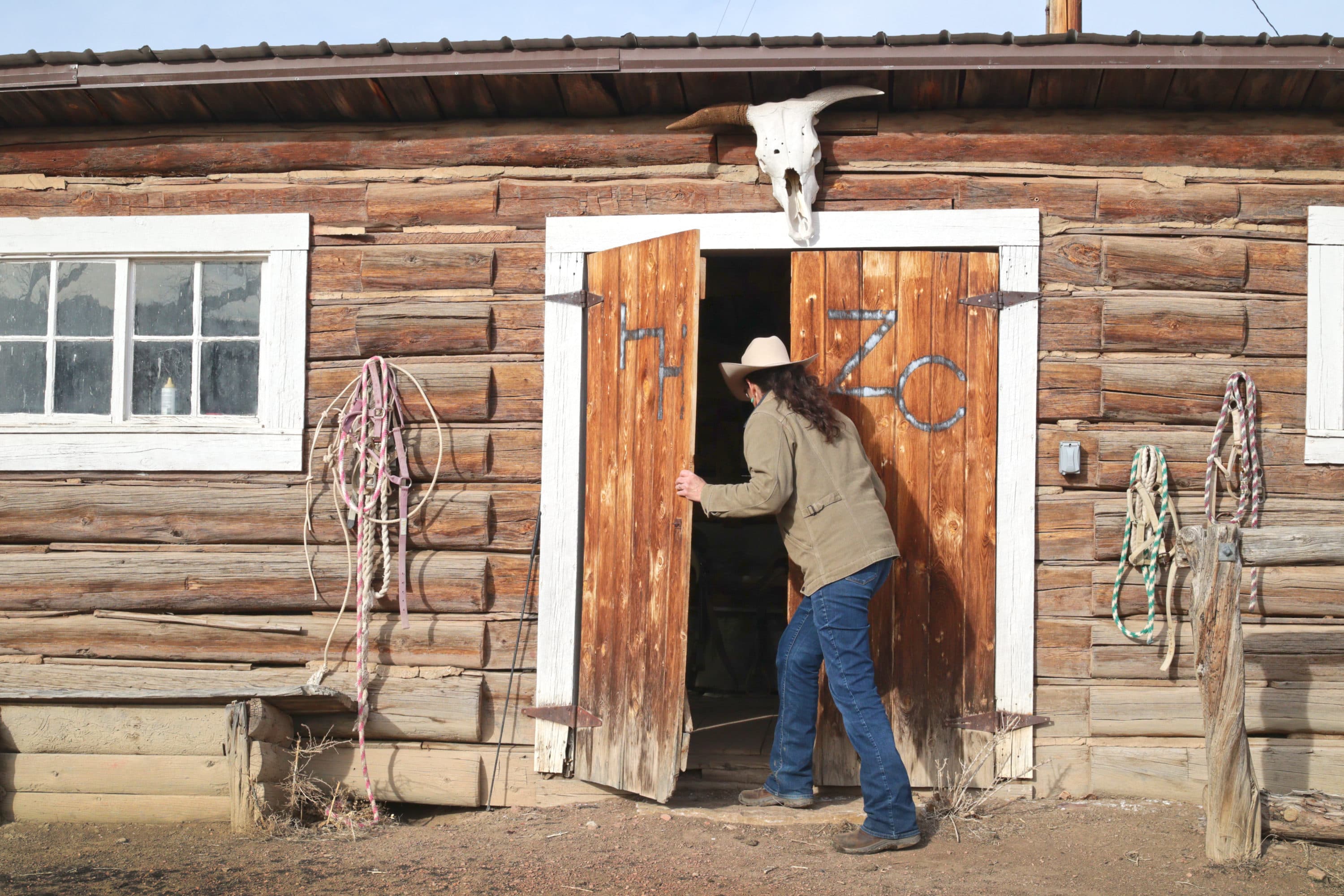
CHAKRABARTI: Jeanie Alderson runs the Bones Brothers Ranch with her husband, her ii teenage sons and her 91-year-quondam father. He raised the cattle earlier her.
ALDERSON: Well, nosotros're feeding a agglomeration of our wagyu beef cattle. And we feed them in the wintertime, and they're out on pastures all summertime. And today nosotros bought them some hay. They're happy to have information technology.
ALDERSON: In many ways, I vest to this place kind of more than it belongs to me, and that's something that's sort of difficult to explicate. Simply I feel this immense responsibleness to intendance for it, and to hold it together.
ALDERSON: So nosotros dear this. This is our solar well, water our cattle and get drinking h2o sometimes if nosotros lose power at the ranch.
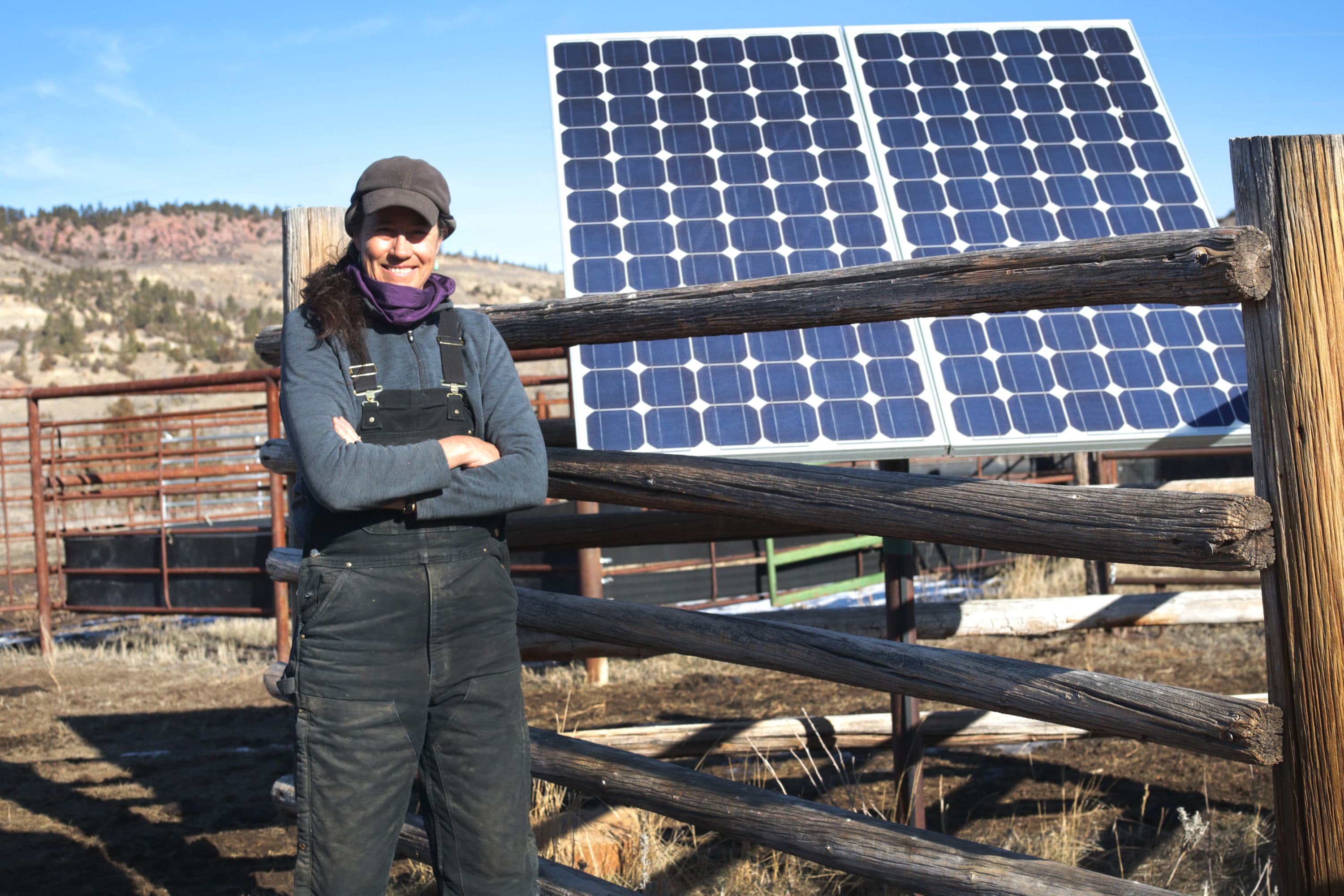
You know, when I was growing up, I don't recall thinking virtually, Are nosotros going to get a large enough sale to pay all our bills and stay in business? That is looming more and more.
CHAKRABARTI: There are 4 major corporations in the American meatpacking industry. Tyson Foods, Cargill and ii owned past Brazilian corporations, National Beef Packing Company and JBS. In 1977, the Large Four, equally they're commonly called, owned merely 25% of the market place. Many mergers later, the Big Four now command 85% of all meat packing in America. Cattle beef are a $67 billion industry in the U.Southward.
Cattle ranchers used to receive 62 cents for every consumer dollar spent on beef. Today, that'southward dropped to less than 37 cents on the dollar. Meanwhile, the Big 4 have tripled profits in the by two years solitary.
ALDERSON: I'm but using a pitchfork to throw a little bit of hay for these horses. They'll mostly graze, but I only requite them a niggling actress.
CHAKRABARTI: By controlling almost the entire meatpacking market, the Big Iv exercised enormous leverage over prices they'll pay for livestock.
ALDERSON: We expect for a middleman to come up and say, OK, I'one thousand going to give you such and such price for your calves. It's non like we get to fix the price. We are given a toll and we have to take it or leave information technology. It'south stressful because we know how much we have to make on a dogie. But we also, considering of where we live in the wintertime, we could say, OK, nosotros can't become a good enough price. We'll just continue them and we'll sell them. The next twelvemonth, we'll sell them every bit yearlings. But then nosotros have all these costs of feeding them all through the winter. And who knows if the market'southward going to be any better the side by side year? We're really trapped in this organization. We don't accept another identify to get. That's the other thing that I think a lot of people don't sympathise. Nosotros don't accept some other market to go to.
CHAKRABARTI: In that location was a fourth dimension and a place where cattle markets were much more competitive, dynamic and transparent: At the public sale.
Today, less than xxx% of cattle sales passed through the typical cash auction. The remainder become through contract sales with the Big Four meatpackers. Jeanie Alderson says that means the company's lock upward 70% of cattle sold at prices they impose, and they practice then out of public view.
ALDERSON: In that location's this huge corporeality of wealth that's beingness extracted from the cattle that we're raising, and they're kind of existence stolen from us. And nosotros're non asking for a lot. Nosotros're really only asking for a fair and open and transparent market, some competition in the market and for some laws to exist enforced.
CHAKRABARTI: And what if that doesn't happen? What if the Big Four meatpackers further consolidate into the big three, two or one?
ALDERSON: We're not going to have the kind of ranching that we know now. If we don't modify things, we're but not going to have these ranches. ... And that'south such a huge cost to all of the states in this country.
CHAKRABARTI: Jeanie Alderson. She's a fourth generation rancher at the Bones Brothers Ranch in Birney, Montana. She'due south also a member of the Northern Plains Resource Council, a grassroots conservation and family agriculture grouping.
Well, let'south turn now to Bill Bullard. He heads the advocacy grouping Ranchers-Cattlemen Action Legal Fund. He's also a old rancher, and he joins us from Billings, Montana. Bill, welcome to the show.
BILL BULLARD: Howdy, Meghna.
CHAKRABARTI: And then in that location'southward a lot to dig into. Considering I really desire to help listeners sympathise every bit much as they tin near how the beefiness industry works, y'all know, from ranch to dinner table. So first of all, can you give us a moving-picture show of where we are at present? Number of caput of cattle in the United States, number of ranches, et cetera? How would you describe that?
BULLARD: Well, we accept most 729,000 independent cattle producers to ranchers left in the U.s.a., and that's a decline from i.3 million head just a few decades ago. Today, nosotros have half-dozen million head fewer cattle in our cattle herd than we had in simply the four decades ago. And so our industry is shrinking. And 1 of the marketing outlets that'due south critically of import to ranchers like Jeanie is the cattle feeding sector. And we've lost 75% of all the contained cattle feeders in this industry merely since 1996.
And so that's in about 25 years. Then the unabridged industry is contracting at an alarming rate, and that'due south considering the regime has de-emphasized the family farm and ranch organisation of agriculture that is a disaggregated arrangement, and has earned the envy of the entire world for producing an abundant, affordable and safe food supply.
And instead, there's been catering to the large corporate agribusinesses in pursuing the largeness of calibration. And as a result, we've seen these monopolistic structures within the industry that's essentially purged contest from throughout the entire industry. And that'due south why you could say that cattle producers are dropping like flies correct now. We're losing our competitive infrastructure inside the entire marketing organization. And if something isn't washed very, very quickly, we'll soon accomplish the betoken of no return, as Jeanie indicated.
CHAKRABARTI: And when you say if something isn't done very quickly, I mean, how quickly are you talking nigh? I hateful, if we look v, x years into the time to come, what practice you run into?
BULLARD: Manner too tardily. Nosotros've got to do something this year. We've got to restore contest. Because there are ranchers that are going broke, that are selling out. We've got additional feedlots that are endmost their doors. And in one case you lose the competitive infrastructure, it's game over for the unabridged industry. And nosotros'll look like the hog industry, where 90% of all the producers in business just 40 years ago are gone today. And that's considering the corporate agribusinesses have substantially controlled that manufacture from birth to plate, as they take in the poultry industry.
So the ranching manufacture is the concluding frontier, and meaningful reforms need to be implemented immediately or we will soon become, as Jeanie said, different what we know the ranching industry today. It will be completely different.
CHAKRABARTI: When we come up back, we're going to talk a lot more than about exactly what the choke points are, where this consolidation is happening near rapidly in the beef and ranching industry. Today is office 1 of our special weeklong series called More than money: The toll of monopolies in America. We'll take more than when we come dorsum.
Part II
CHAKRABARTI: This is On Bespeak, I'm Meghna Chakrabarti. And today is role one of our special week-long series that nosotros're calling More money: The toll of monopolies in America, where we're taking a look at the idea now championed by the chair of the Federal Trade Commission, that monopolistic business practice isn't merely bad for consumers, simply it may be bad for American democracy. Then that'due south what nosotros're taking a look at over the course of this week.
And today we're focusing in on what's happening right now in the American beef manufacture, specifically. All the way from cattle ranchers, to what happens in the supermarket. And I'g joined today by Bill Bullard. He heads the advocacy group the Ranchers-Cattlemen Action Legal Fund. And they brought a class action lawsuit against meatpackers in America, and nosotros'll talk most that in just a infinitesimal. So, Nib, tell me a little bit more than. Let'southward go a good agreement of how the process works correct now. So the ranchers raise the cattle, and and so where exercise the cattle become adjacent?
BULLARD: Well, there are several segments of the live cattle supply chain. And then ranchers like Jeanie will raise a calf off of the mother cows that she will care for throughout the year. And that dogie would be sold, perhaps by Jeanie, in the fall. Weighing betwixt 400 or 500 pounds. It would then move to an intermediary segment of the industry that will abound that calf for several more than months, maybe another half dozen months. So the calf volition ultimately counterbalance 800 to 900 pounds, [and] would exist brought to the feedlot sector of the manufacture. And that'due south where the brute is fed the concentrated nutrition, gains weight at a very fast step. And and so when the beast weighs approximately 1,300 pounds, it will exist sold straight to the packers. And as you indicated, there's iv packers controlling 85% of that market.
CHAKRABARTI: Let's talk a little fleck so well-nigh how Tyson, Cargill, National Beef Packing Company and JBS became the ascendant forcefulness in the meatpacking industry. Wasn't information technology about, I don't know, forty-ish years ago that information technology was a lot more than distributed across the The states? Because it was just back in the 1980s, as I said earlier, that they had, what, 25% of the manufacture. Then how did that alter and then rapidly?
BULLARD: Well, that'south considering the corporate agribusinesses went to Congress and the executive branch and convinced them that what the American family unit farm and ranch organization could do well, they could do ameliorate. And and so they pursued this ideal of largeness of calibration. The larger the enterprise, the greater the efficiency, and the more consequent the quality. And every bit a result, we began losing hundreds of thousands of cattle producers all across the country. Because in that location was a paradigm shift in the laws, and regulations and policies that provide the framework of this industry. And those laws, and regulations and policies catered to the interests of the multinational meatpackers. To the disadvantage of the producers, the cattle producers, also as to the consumers.
CHAKRABARTI: Well, there is, though, a law, speaking of laws and regulations, that'south been on the books since 1921, right? The Packers and Stockyards Act of 1921. And if I read that properly, this is a law, it'due south century-quondam now, that was supposed to keep exactly the kind of consolidation nosotros're talking about, well beneath 40%.
BULLARD: That'south right, it went across what our U.Southward. antitrust laws did. Because not only did information technology prohibit monopolistic practices in the industry, but it was designed to protect the interests, the financial interests of actual farmers and ranchers. It was designed to ensure that the meat packers would not engage in deceptive, or discriminatory or unfair practices against producers. As well as that the packers would not provide undue preferences or advantages to some of the feedlot sectors, to the disadvantage of others. In other words, if they're given sweetheart deals to some of the largest formula feeders, cattle feeders that have close alliances with the packers. And that's why we've seen our smaller, contained, family-sized feedlots get past the wayside. We've lost over 83,000 of them in just 25 years.
CHAKRABARTI: But tell me more, though. I hateful, ostensibly when we have a law that's on the books that says consolidation shouldn't become above xl%, and then it skyrockets from 25% in the early 80s to 85% 40 years later, something has gone wrong regarding regulatory enforcement.
BULLARD: Well, that's correct, there is lack of enforcement. In fact, the U.S. Department of Agriculture, that was charged with implementing and administering the Packers and Stockyards Human action, never even wrote rules to clarify what Congress meant past protecting producers against unfair, and deceptive and discriminatory practices. And and then the packers were left to operate with impunity in the marketplace. And the Packers and Stockyards Act was not enforced.
CHAKRABARTI: OK, and then tell me a picayune scrap more than. Once more, for people who aren't familiar with this. In the first segment, we talked well-nigh how the conventionalities amidst cattle ranchers, what you're seeing now is that considering of this pinch point in the middle of the process with the four big meatpackers — And by the way, we did reach out to Tyson, Cargill, National Beef Packing Company and JBS. They did non get back to us.
Bill, how is it that you say that they're able to substantially set prices? Clarify that.
BULLARD: Well, because of the dominant market position that they enjoy in the cattle industry, they can deed as gatekeepers to the market. And they tin can decide who does and who does non have timely admission to the marketplace. And as a result, they can provide preferences to their large, closely aligned feedlots. And completely deprive the independent cattle feeder of the same types of prices and terms in terms of selling cattle. So that's ane manner that they were able to. The other way is they've implemented new cattle procurement tools, tools with which to buy cattle.
And what they've done is they've shifted large volumes of cattle out of the competitive cash market, which is the industry'south price discovery market place. And they identify those cattle in underpriced frontward contracts. We call those captive supplies. The manufacture wants to call them alternative marketing arrangements, because they audio better. The fact of the matter is is they are the instrument of choice by the packers to leverage downwards the cattle prices that they pay to U.S. producers. And that's exactly what's happened in our industry.
CHAKRABARTI: How much have they been able to leverage it down?
BULLARD: Well, consumers need to know that they are paying super inflated prices for beef today in the grocery store. And yet cattle producers continue to receive seriously depressed prices. And so they take depressed prices from $167 per hundred weight for an animate being, down to we were as low as $100 per hundred weight within the last few years. And very recently, cattle prices have started to increment. At present up to around $140 per hundred weight.
Just very importantly, based on USDA data, that means the independent feeder has, over the past vii years, has lost on average $69 per caput of every creature they fed and sold to the packers. So that explains why we've lost so many independent feeders. And so what'southward happened in the industry is the consumers are existence exploited on i end of the supply chain, and cattle producers are being exploited on the other stop. And every bit you lot indicated, the middlemen are making record profits.
CHAKRABARTI: You know, I'm looking at a USDA chart here. And it's like a visual representation of what you exactly described at that place, Bill. That from 2010 to roughly 2015, in a sense, the price that ranchers got per hundred weight, and the toll of beef in the consumer market place, kind of tracked pretty closely. Only then starting in 2015, we accept this giant divergence, just like crashing of cattle prices. And a steady and so ascension rate for the toll of beefiness. So it'southward that deviation that's driving the ranchers out of business, is what you lot're talking about.
BULLARD: That's right, there's always been a harmonious, synchronous relationship between beef prices and cattle. And that makes sense, because the merely ingredient in beef is cattle. But subsequently 2015, we saw cattle prices inexplicably collapse for over a yr. And we saw it outset in 2017, nosotros saw these two price points moving in absolutely opposite directions. Nosotros saw consumer beefiness prices rising to best record highs. And at the same fourth dimension, we saw cattle prices stair stepping down. And that indicates that competition has been purged from the unabridged live cattle supply chain.
CHAKRABARTI: And you're maxim that the delta goes into the profit of the Big 4.
BULLARD: The meatpackers are making all-time record margins, and accept been for many years. While cattle producers are struggling just to receive the cost of production from the market place. Many are failing to do and then. Meanwhile, consumers proceed to pay these super inflated prices for beef.
CHAKRABARTI: So I desire to become your response to some of the things that the meatpacking industry has said in response to these criticisms. Once more, just desire to remind anybody we did reach out to Tyson, Cargill, National Beef Packing Co. and JBS. Did not hear back from them. But, there has been a lot of testimony on Capitol Hill nigh this. Shane Miller is grouping president of Tyson Fresh Meats, and he testified before the Senate Judiciary Committee in July of just last yr. And here'southward how he answered a question from Iowa Sen. Chuck Grassley about that meat packing visitor profit-taking.
SEN. CHUCK GRASSLEY [Record]: Cattle producers struggle to suspension even, receiving average bids of approximately $118 per hundred weight. The gross packer market exceeded $1,000 per head. How practice you justify making such depression bids when yous're turning such a significant turn a profit?
SHANE MILLER: What we pay Iowa cattle feeders truly depends on the market weather condition. But how they end up deciding to sell their cattle, whether they want to negotiate or put them on an AMA, is totally up to them.
CHAKRABARTI: So Bill Bullard, the AMA in that location he's mentioning, being that culling meat market place. He's proverb that the ranchers, the cattlemen and women out in that location take a option.
BULLARD: And they certainly exercise not, and that's considering of the perishable nature of cattle. In one case cattle have reached that optimum weight of approximately 1,300 pounds, at that place's a narrow window of opportunity to sell those animals, and it'southward almost a two to three week window. If you go beyond that, the beast begins to degrade in quality and the cattle feeder is uneconomically continuing to feed those cattle, they become overweight and the cattle producer loses money. Now the meatpackers know this, and they have a tremendous bargaining advantage over the independent producer.
Because again, you lot have four packers acting as gatekeepers. They can make up one's mind who does and who does not have timely access to the market, so they create market access risk for producers. And of form, in our lawsuit, we've alleged that the meatpackers have conspired to reduce the slaughter volume in order to balance supply and demand. To ensure that there is never more than demand for cattle than there is in bachelor supply.
And we talk about these AMAs because what happens when the meatpackers shift cattle out of the greenbacks market, and when they avoid the greenbacks market, they back up cattle that the contained cattle feeders feeding. And that incentivizes that feeder to do i of ii things. Either to sell for a low, low cost or jump into one of these AMAs in society to gain timely access to the market, regardless of what the price is going to exist. Considering no price is determined at the time of the transaction.
CHAKRABARTI: Yeah. Y'all know, the meatpackers say that basically the problem isn't the consolidation and their marketplace dominance. The problem is all of these other factors that are out of their control. I hateful, for example, hither is Dustin Aherin. He's now director of strategy at Tyson Fresh Meats. June of last twelvemonth, he was with Rabo AgriFinance. And that month, he testified before the Senate Ag Committee on what he says actually drives cattle prices in the U.S.
DUSTIN AHERIN [Tape]: A working market sends toll signals to accommodate. These same cost signals created record high cattle prices and record packer losses in 2014 and 2015. The biology and natural time delays of the beef industry brand it slow-moving and upper-case letter intensive, adjustments take years. While recent unforeseen events have exacerbated the situation, free market signals, economic losses, drought and the natural cattle cycle laid the foundation for today's circumstances over several decades.
CHAKRABARTI: What's your response to that, Bill?
BULLARD: Well, what's missing hither is that we exercise not have consumers sending demand signals upstream in the beef supply concatenation. And they cannot, because there is no indication as to the country of origin on the beefiness. And without that country of origin label, the meatpackers can substitute imported products from over 20 countries, and displace the American cattle producers access to their ain domestic market. And that's what we've seen. Considering we cannot have consumers indicating that they want cattle produced from American cattle producers. The meatpackers take been free to import large quantities of beefiness and cattle from foreign countries such as Namibia, Africa, Costa rica, Honduras, Nicaragua, Argentina, Brazil, Canada, Mexico, and pass that off to unsuspecting consumers. But the effect of that is ... to reduce need for domestic cattle, and that reduced demand in the competitive cash market place is what helps drive the prices downwards.
CHAKRABARTI: Well, here's the outcome of some of this. Nosotros likewise talked to Aaron Metz of Wishek, N Dakota. He's a fourth generation rancher, and he and his wife are selling their cattle herd off today.
AARON METZ: It hasn't really hit me hard still, considering the cows are even so here. But on Monday, when they go ... I don't know what's going to happen to me. I'll probably fall apart. When y'all come across years and years of genetics that you accept worked for. Y'all have froze for. You accept sweated for. You lot take bled for. Going down the road is ... center wrenching.
CHAKRABARTI: Aaron says that this was one of the hardest decisions he's e'er had to brand. Simply when he sat down and ran the numbers last month, he realized he could not afford to ain the cows anymore.
METZ: Where I'm sitting right now, I'yard looking out my window. And I can run across my barn. And up on my barn is my make. My make was my grandpa's, in the family 120 years, that ane brand. And my plan was to pass it on to my son. And when you await at that make, that's the symbol of the legacy of my family. My grandpa came over here on a ship from Frg. You lot know, he homesteaded, xvi-years-erstwhile. So that tells you a lot about the people that are doing this and the heritage that'southward behind it. It's kind of a sad deal to even sit hither and look [at] it. Because that might not be in the family much longer.
CHAKRABARTI: That brand he's talking almost, past the mode, is the symbol of the Green Lake Angus Ranch. And Aaron told us ranching is all he and his family unit know. But he thinks that past the cease of this year, all of that'south going to alter.
METZ: Once the cows are gone, and nosotros have a product sale in March, conclusion has to come. What'due south adjacent? Do we sell the land off and move to town? Or practice we stay here and calibration? You know, just do a hobby deal, and nonetheless work in town? Or practise we just just go a whole unlike direction? In that location's a lot of tough decisions to exist made. You know, at this point, it's kind of looking like we're going to probably end up going and getting a job somewhere. Whether we live on the farm place and we do something with the country or whatever, information technology's kind of looking like we're going to boondocks. Y'all know, it shouldn't be that way, where y'all have to exit your identify to make a living. You should be able to make a fair enough living off of your farm or ranch, to take intendance of your family. Information technology should but be that way. Things have actually, really inverse in the last 30 some odd years.
CHAKRABARTI: Fourth generation rancher Aaron Metz, in North Dakota. When nosotros come back, we're going to be talking almost some solutions and the pushback against the monopolization in the beef industry. This is On Betoken.
Part III
CHAKRABARTI: Today is twenty-four hour period 1 of our special weeklong serial that we're calling More money: The cost of monopolies in America, where nosotros're taking a look at this thought now championed past the chair of the FTC, Lina Khan, that monopolies in America don't just impairment consumers, they harm democracy.
And so today, in part ane, we're taking a close expect at the radical and rapid changes that have happened in the beef industry in the by 40 years, and what impact that's having on ranchers, consumers and also more than broadly on democracy. And Bill Bullard joins us. He'due south head of the advancement group the Ranchers-Cattlemen Action Legal Fund. As well, a former rancher himself, is with the states from Billings, Montana. And I want to play a little bit of tape from just final calendar month because this upshot has gone all the mode to the White House. Here's President Biden at a virtual roundtable with farmers and ranchers in January.
PRESIDENT JOE BIDEN [Tape]: Dorsum in July, I signed an executive guild to promote contest beyond the economy. And too many industries, a handful of giant companies dominate the market place. And too often they apply their ability to clasp out smaller competitors and stifle new entrepreneurs, making our economic system less dynamic, giving themselves free rein to raise prices, reduce options for consumers or exploit workers. The meat industry is a textbook example, on the price side. I've said it before, and I'll say it again. Commercialism without competition isn't capitalism, it'due south exploitation.
CHAKRABARTI: President Biden only last calendar month. The Biden administration has proposed better enforcement effectually things like the Packers and Stockyards Deed that nosotros talked virtually. And $1 billion to expand contained meat processing capacity. And $100 million to support hiring the workers that would be needed for an increased number of meat packing facilities. Will information technology brand a deviation, Nib?
BULLARD: The problem is that y'all do not first address the abuse of marketplace power being exercised in the marketplace today. We're probable to see a repeat of the '80s, which was considered a merger mania decade. And that's because the meatpackers used their leverage in order to strength all of the local and regional packing plants out. So having more packing plants will increase chapters. And some volition survive, but some are going to be subjected to the same kind of monopolistic-type behave in the marketplace. Unless nosotros beginning aggressively enforce the antitrust laws, the Packers and Stockyards Human activity. And in fact, this crisis is and then severe it's at present become a national nutrient security outcome. And Congress needs to act decisively in order to immediately restore contest to the industry.
CHAKRABARTI: OK, then specifically, then what would that mean? I mean, you lot have a lawsuit working its fashion through the courts now. Only ideally, enforcement could come independent of that.
BULLARD: Well, that's right. And for ranchers like Aaron, it's as well late. And his story is being replicated all across the United States. And as I said before, we'll soon reach the betoken of no return. Then lawsuits take a long time. Congress needs to human action decisively. They know there's a problem. The president has identified the problem, and articulated information technology. Congress needs to act right now to prevent whatever farther ranchers from having to exit the industry, simply because the marketplace is fundamentally and systemically cleaved. Because the regulators have not enforced antitrust laws, or the Packers and Stockyards Act, for decades.
CHAKRABARTI: Well, as I said, we did speak with the North American Meat Institute. They stand for a lot of meatpackers. And spokeswoman Sarah Little told the states that the Meat Institute does not think that the Biden plan or the additional $1 billion of authorities funding to expand meat packing capacity, doesn't think that that will work.
SARAH Petty: The get-go problem with spending that money to invest in extra capacity is, Is it sustainable? Where volition they get the labor to operate this new capacity, given the nationwide labor shortage? What will happen is they will create too much packing capacity, and nosotros will not accept plenty cattle to run through those facilities. The herd size is shrinking. USDA reports each month on the herd inventory in America. And it has been consistently falling. Then nosotros're but saying that the new chapters supported by the government is non the answer to ameliorate prices for livestock producers.
CHAKRABARTI: That's Sarah Little, a spokeswoman for the N American Meat Institute. ... [Joining us now] is Claire Kelloway, program managing director for fair food and farming systems at the Open Markets Institute. She's with us from Minneapolis.
... Showtime of all, I mean, just respond quickly to what you heard Sarah Little say. It sounds like they're asserting that information technology'due south not at all chapters, or an expansion of capacity, that will solve the problem. What exercise you lot think?
CLAIRE KELLOWAY: I mean ... what kind of chapters are you talking about? I recollect the system that we currently have proved very frail. And nosotros do meet that large meat packers, when they don't confront sufficient contest, don't have that incentive to invest in their capacity and critically invest in resiliency, and take backups and contingency plans. They both, as Pecker has been talking nigh, have an incentive for there not to be a lot of excess processing chapters. Then they can actually control the supply of cattle. Just they also are nether a quite restrictive system that is really focused on operating at full capacity all the time. And what we've seen is a resilient meat supply system actually requires a diversity of both scale and some large plants. But also large plants owned past multiple packers, and more medium-sized plants that can fill in when some of these big plants get down.
CHAKRABARTI: Yes. So it's interesting to me. Considering this consolidation in the eye of that supply chain, between ranchers and the grocery shop was allowed to happen, right? I hateful, we went from that 25% among the Large 4 to the 85%, information technology was allowed to happen. And how unlike is that Claire, if at all, from ... other types of food, poultry, pork?
KELLOWAY: Yeah, the beef packing industry is certainly more consolidated than pork and chicken. They obviously all have slightly different supply chains, simply there definitely has been an overall trend across meat processing and nutrient processing generally towards consolidation. Sort of aligned with when merger policy was actually less restricted, and more than mergers were permitted beyond the manufacture. So certainly beefiness is both more than full-bodied, but also all industries are tending towards concentration.
CHAKRABARTI: And just to exist clear and correct me if I'm incorrect, but for instance, in poultry, what you have is really vertical consolidation. Is that right?
KELLOWAY: Yep, vertical consolidation. But also there are high degrees of horizontal consolidation at the regional level. So almost half of all chicken farmers report having just i or ii chicken processors to sell to.
CHAKRABARTI: Got it. OK. Nosotros're running out of time here. Then Bill, permit me just get down to essentials here. First of all, we should admit that Senator Chuck Grassley is trying to get legislation through Congress that would, for example, crave that 50% of cattle get through open up public auctions, versus the smaller percentage at present. Would that help?
CHAKRABARTI: Absolutely. That is how we could restore competition for domestic cattle in the U.S. market. Nosotros must forcefulness the packers to again begin competing in the competitive marketplace. So the Senator Grassley's beak, is Senate Bill 949, is critically important. But the other measure is we accept to empower consumers to begin sending those demand signals throughout the supply chain. And the only mode they can practice that is with a mandatory state of origin characterization. So they tin choose to back up the domestic supply concatenation, the American cattle farmer or rancher, or choose to purchase beef produce under another country's food safety regime. Such as Namibia, Africa or Uruguay or Costa rica, Nicaragua or whatsoever one of the 20 countries.
And so those are the ii triage measures that are needed immediately in gild to begin restoring competition to the market place. And one important factor hither. The cattle industry is the single largest segment of American agriculture. Pregnant it'due south vitally important to rural communities all across America. Merely information technology's also unique because it under-produces for the domestic market. And then our industry is shrinking in terms of number of producers, number of cattle, number of feedlots. And at the same fourth dimension, imports are increasing. And so they're displacing and essentially preventing the U.S. cattle industry from even growing. Then that'south the fallacy behind the North American Meat Establish's statement, is that there is demand for beef. It's simply beingness brought in offshore, every bit opposed to beingness produced here in America.
CHAKRABARTI: Well, Bill Bullard with the Ranchers-Cattlemen Action Legal Fund. Joining us from Billings, Montana. Bill, thanks and so much for being with united states of america today.
BULLARD: My pleasure. Thank you.
CHAKRABARTI: Claire, I've got one more question for you, earlier we have to turn a corner here. You know, our big pic analysis across this week is trying to explore the assertion that the current FTC chair, Lina Khan has. That monopolies are not just bad for consumers, but bad for democracy. That's a very big statement. Do you recollect that rings true or not in the case of what we're talking about with the beefiness industry?
KELLOWAY: I think it does. And I think it'southward really connected to the antimonopoly tradition in the United States, and the reasoning behind some of these laws beingness introduced way dorsum when. But, really, corporate power in the terms of economic power and the size that some of these corporations take accommodated to, also translates into political power. And nosotros're seeing right now just how challenging information technology is to regulate what is very clearly an issue with skyrocketing prices, with all the disruption we've seen, with farmers seeing such persistent low prices. The evidence is clear. And yet information technology is such a political struggle to enforce laws that are on the books and reform the system. So I think absolutely full-bodied corporate power translates into political ability. And that'due south a threat to enacting democratic policies that people, ranchers, consumers are request for.
CHAKRABARTI: Well, Claire Kelloway, with the Open Markets Plant. Thank you so much for joining us.
KELLOWAY: Yes, cheers for having me.
CHAKRABARTI: Permit me turn at present to Jack Beatty, On Betoken news annotator. He's going to exist with the states throughout this week. Hello there, Jack.
JACK BEATTY: Hello, Meghna.
CHAKRABARTI: OK, so y'all've been listening along, Jack. I hateful, how do you meet what'due south happening with the beef industry in the broader flick of American corporate ability in the past 20, 25 years?
BEATTY: Information technology's really the story of what'southward happened to American corporate power. According to one study, 75% of industries saw more concentration, just in the terminal 15 years. These include lighting and bulb manufacturers, four companies controlled 90% of the market place. Tires, four companies, 90%. Household appliances, four companies, ninety%. Sanitary newspaper manufacturers, four companies, 92%. Beer, one company has 70%. And of class, in that location's big tech, nosotros're going to go into tomorrow. Just wherever y'all wait in the American economic system, this is an age of oligopoly and/or monopoly.
CHAKRABARTI: Well, you heard Beak talk well-nigh the fact that at that place are laws already on the books correct at present that could exist enforced, that might accept headed off this consolidation in the beef manufacture. So again, it but always requires regulatory and political will. Practice y'all see that potentially emerging in the face of this seismic sea wave?
BEATTY: One would similar information technology to be, simply it'south far too seek. Y'all know, polls of what people think of large business shows basically half and one-half. Half like it, half don't. But yous know, there was a kind of route exam in the last campaign of, Do you want to break monopolies? That was the foundation of Elizabeth Warren's entrada. She came fourth in New Hampshire. She came third in her own land. People weren't listening. It wasn't what they thought of every bit the major problem.
Maybe i problem with her position and with, you know, ripping up public support for this is the connexion with inequality. Are the two things related? You know, the concentration of industry and the share of national income going to the meridian one%. In 1969, that was eight% of national income went to the summit 1%. Today, information technology'south a quarter, 25%. Are the 2 things related? Are all of us somehow beingness impoverished by this great concentration at the peak? We'll have to see how that argue goes.
CHAKRABARTI: Jack, give us like a like a i minute preview of what'south coming down the pike next week, specifically on this bespeak. Considering you accept written unabridged books well-nigh the political civilization at the heart of the previous corking moving ridge of antitrust action in this country a century ago. How dissimilar is the culture that you just talked about now, the political civilization versus then?
BEATTY: The big difference is ideas accept changed. And nosotros're going to get into this. The role, particularly of the Chicago School of Economic science, on jurisprudence and understanding what antitrust is. Everything at present in the legal profession comes downwards to, Is it a monopoly if the price is remains low? If the consumer gets a bargain, there'south no damage done. And the leader of this, of grade, was Robert Bork, whose book was massively influential. And it is all the same the example that the courts are the gatekeepers hither. And the courts are permeated, pervaded by people, past judges, lawyers, the institution bar that believe that idea. That antitrust is a faded passion, as Richard Hofstadter called it, a fading passion of American reform. We don't need information technology. We're getting cheap appurtenances. That'southward plenty. No other damage arises from monopoly, huh?
CHAKRABARTI: Well, as Jack said, tomorrow we're going to exist looking at the tech sector, specifically. Considering FTC Chair Lina Khan has actually made her career focusing on monopolistic practices in the tech sector. So we'll be talking about what the proposed merger between Microsoft and Activision Blizzard might tell us. Jack is joining us for the full 60 minutes on Wednesday, where we're going to go back in fourth dimension, a century or more than. And talk near the previous large waves of antitrust fervor in this state. And and so equally Jack mentioned, on Th, we're doing a prove that'll take a look at Robert Bork'southward influence on how antitrust is defined in the United States. And and then on Friday, we're going to enquire this question almost whether Lina Khan and Elizabeth Warren are request the right question well-nigh problems with commonwealth, problems with inequality. But is focusing on monopolies the wrong solution to the right question? So Jack, are yous looking forward to it?
BEATTY: I am. I'grand keen.
CHAKRABARTI: OK, well, we'll be hearing from Jack every single solar day this week during our special series More money: The cost of monopolies in America. I'm Meghna Chakrabarti. This is On Point.
This transcript has been edited and condensed for clarity.
From The Reading List
Large by Matt Stoller: "Beef Is Expensive. So Why Are Cattle Ranchers Going Bankrupt?" — "During the Covid pandemic, Americans went to the supermarket and establish something that hadn't happened for decades - a meat shortage. There was plenty of cattle, but the beef wasn't getting to the supermarket shelves."
TIME: "U.South. Food Prices Are Upwards. Are the Food Corporations to Blame for Taking Advantage?" — "2021 was a bad twelvemonth for grocery bills. Shoppers paid half dozen.4% more for groceries in November 2021 compared to November 2020, co-ordinate to the consumer price index."
Source: https://www.wbur.org/onpoint/2022/02/14/more-than-money-monopoly-and-meat-processing

Post a Comment for "Is Big Ag Making Money on Beef Sales"