Stuart Keith Are Video Games Art the Debate That Shouldnt Be
Our series The Artists has made the case that the creators who shook upwardly the world with their groundbreaking games are indeed capital-A Artists.
In 2010, Roger Ebert famously wrote: "I remain convinced thatin principle, video games cannot be art." Throughout its 10 episodes, our series The Artists has made the case that the creators who shook upward the earth with their groundbreaking games are indeed capital-A Artists and should be recognized as such. Only in a globe where so many are experiencing beauty and significant in games, but similar they would from other artforms, this whole dispute seems beside the signal. Every bit games critic Keith Stuart puts it: "Are games fine art or aren't they? Nobody need answer. Games are beautiful and of import — we can leave it at that place and know that nosotros are correct." Watch the full episode. But if game advocates practice still have to make this case for games as fine art, they have a powerful ally on their side: the Museum of Modern Art in New York, which is now featuring games as role of the Practical Pattern exhibition. "Nosotros knew that in that location would be a agglomeration of people objecting to 'desecrating the halls of our temple of modernism' with what is not often seen equally a serious form of inventiveness," says the MoMA's Paul Galloway. "[Games are] i of the almost important art forms of the 20th century and the 21st century in detail." Galloway sees the resistance as predictable. "Anytime you're introducing something new, people are shocked by information technology. When you're breaking new ground at that place's always a bourgeois reaction confronting that." Fifty-fifty with the MoMA accepting games into its hallowed halls, gaming still has a broader perception problem: it's oft seen as little or just for certain people. Tracy Fullerton, the chair of interactive media and games at the Academy of Southern California, sees games as an aboriginal and possibly cardinal man pursuit. "I think of games as an aesthetic form that may well predate the story," she says. Despite this long history, games in many ways became pigeonholed when they made the transition to the computer. "Video games endure from an unfortunate serial of events where soon after their introduction, they began to be ghettoized in a item way, for a item marketplace," Fullerton says. "For a very long fourth dimension, we've seen video games marketed to a unmarried populace of young boys. At that place's just an assumption made about who plays video games. And, of course, the assumption is untrue." In improver to the demographic pigeon-holing, Fullerton sees an unnecessary cultural partition betwixt video games and artists in other mediums. "Traditionally, you haven't seen a lot of overlap between the people making games and the people making films, art, sculpture, painting, music. These are non crowds that hang out and influence each other." For Fullerton, this isn't just an abstruse bookish matter — she feels that these cultural forces guided her life abroad from games for a long time. "I find it very telling that I never considered games equally a career, generally because they weren't defined as an expressive medium." Fullerton eventually found her way to expression within games, creating Walden, a game that expresses — and lets the player experience — the ideas of Henry David Thoreau'south famous philosophical account of his fourth dimension spent at Walden Swimming. "I wanted to make a game that had that alternate philosophy at its core, and the rewards don't come up in terms of more stuff, or levels. The rewards come in terms of experiences." An earlier episode of The Artists looked at the early days of Electronic Arts, where the artists behind the games were historic in much the same way equally a motion picture managing director. EA stopped this practice, but artists such as Take chances creator Warren Robinett remember this early ideal fondly. "The thing most EA that's incredible is where they started, and the vision of what they wanted to exist — this place for artists. It was designed for the video game creator." Games have become a big business, and that corporatization has changed how games are made. "Sometimes there are indie games that are made by a few people, or maybe even i," Robinett tells us. "It's all the same possible for an individual to make a video game, simply it'south mostly not washed that way. Nowadays video games are usually fabricated by large teams." Trent Oster, the producer of Neverwinter Nights, sees a loss in this current country of affairs. "We've totally lost that link to the creators who are awesome. At that place were these artists who created experiences on these horribly flawed devices." Cindy Poremba — founder of the Kokoromi Collective, an arrangement which promotes video games equally an art form — argues that corporate game development limits the imagination of what games can exist. "The simply thing that you can be in games is a game developer, every bit opposed to being an artist and you lot happen to make games." "It changes, I remember, the types of things that you might be willing to make." Poremba is hopeful about the future and the possibility of a revival of the video game creator as artist. Fullerton's Walden, for example, exists in a blossoming indie gaming sphere, where artists exist exterior the corporate gaming earth, publishing on platforms such as Steam and with the help of crowdfunding. The Artists was most the creators at the dawn of the video games era. But perhaps nosotros're on the border of a new period, full of creators picking up the dreams of the generation that beginning saw these worlds of possibility within their screens. Watch all 10 episodes of The Artists at present, a new CBC Arts series about the video game designers who changed the world. 
Watch a clip:

From basements to the Museum of Modern Art

We knew that there would be a bunch of people objecting to 'desecrating the halls of our temple of modernism' with what is not frequently seen equally a serious form of inventiveness. - Paul Galloway, The Museum of Modernistic Art
Who are games for?

Traditionally, you haven't seen a lot of overlap between the people making games and the people making films, fine art, sculpture, painting, music. These are not crowds that hang out and influence each other. - Tracy Fullerton, Chair, Interactive Media & Games, Academy of Southern California
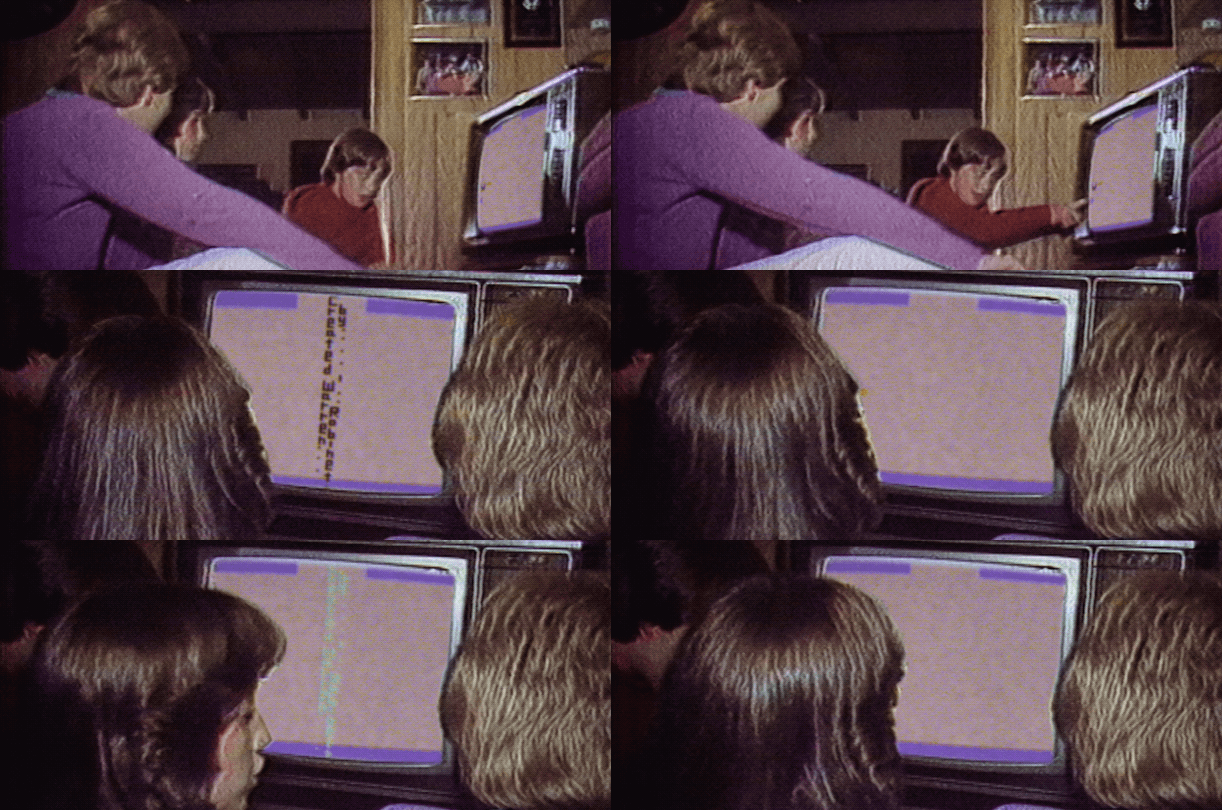

The resurgence of the video game artist?

I notice it very telling that I never considered games as a career, mostly because they weren't defined as an expressive medium. - Tracy Fullerton, Chair, Interactive Media & Games, University of Southern California

Are games art or aren't they? Nobody need reply. Games are beautiful and important, we tin leave it there and know that nosotros are right. - Keith Stuart, video game critic
Source: https://www.cbc.ca/arts/are-video-games-art-does-it-even-matter-they-re-beautiful-and-important-1.4735946

Post a Comment for "Stuart Keith Are Video Games Art the Debate That Shouldnt Be"