Can You Go in Reverse in 4 Wheel Drive
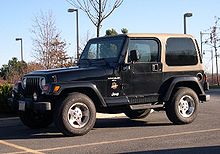
Four-wheel bulldoze, as well called 4x4 ("four by four") or 4WD, refers to a two-axled vehicle drivetrain capable of providing torque to all of its wheels simultaneously. Information technology may be full-fourth dimension or on-need, and is typically linked via a transfer case providing an boosted output bulldoze shaft and, in many instances, additional gear ranges.
A 4-bike bulldoze vehicle with torque supplied to both axles is described as "all-wheel bulldoze" (AWD). Even so, "iv-wheel drive" typically refers to a set of specific components and functions, and intended off-route application, which generally complies with modern use of the terminology.
Definitions [edit]
Four-wheel drive systems were developed in many different markets and used in many different vehicle platforms. There is no universally accepted ready of terminology that describes the various architectures and functions.[1] The terms used by various manufacturers often reflect marketing rather than engineering considerations or pregnant technical differences betwixt systems.[2] [3] SAE International's standard J1952 recommends only the term "all-wheel drive" with additional subclassifications that cover all types of AWD/4WD/4x4 systems found on production vehicles.[4]
4×4 [edit]
"Four-by-four" or "4×4" is often used to refer to a class of vehicles in general. Syntactically, the first figure indicates the total number of wheels (or more precisely: axle ends) and the 2nd indicates the number of beam ends that are powered. Accordingly, 4×ii means a four-bicycle vehicle that transmits engine torque to simply two axle ends: the front two in front-cycle drive or the rear two in rear-wheel drive.[v] Similarly, a 6×iv vehicle has three axles, two of which provide torque to two axle ends each. If this vehicle were a truck with dual rear wheels on two rear axles, so really having ten wheels, its configuration would nonetheless be formulated equally 6x4. During World State of war II, the U.S. armed forces would typically use spaces and a upper-case letter '10' – as "four X 2" or "half dozen X four".[6]

Center transfer case sending power from the transmission to the rear beam (right) and front axle (left)
4WD [edit]
Four-wheel drive (4WD) refers to vehicles with 2 axles providing torque to four axle ends. In the North American marketplace, the term more often than not refers to a system optimized for off-road driving atmospheric condition.[7] The term "4WD" is typically designated for vehicles equipped with a transfer case that switches between 2WD and 4WD operating modes, either manually or automatically.[eight]
AWD [edit]
All-cycle bulldoze (AWD) historically was synonymous with "four-wheel bulldoze" on 4-wheeled vehicles, and vi-wheel drive on 6×6s, and so on, being used in that fashion at least every bit early as the 1920s.[nine] [x] Today in North America, the term is applied to both heavy vehicles and light passenger vehicles. When referring to heavy vehicles, the term is increasingly applied to mean "permanent multiple-wheel drive" on 2×two, four×4, vi×6, or 8×eight bulldoze-train systems that include a differential between the front end and rear bulldoze shafts.[xi] This is often coupled with some sort of antislip technology, increasingly hydraulic-based, that allows differentials to spin at different speeds, merely still exist capable of transferring the torque from a wheel with poor traction to 1 with better. Typical AWD systems work well on all surfaces, but are non intended for more than farthermost off-road employ.[11] When used to depict AWD systems in light passenger vehicles, it refers to a system that applies torque to all four wheels (permanently or on-need) and/or is targeted at improving on-road traction and performance (particularly in inclement conditions), rather than for off-route applications.[7]
Some all-wheel drive electric vehicles use one motor for each axle, thereby eliminating a mechanical differential between the front and rear axles. An example of this is the dual-motor variant of the Tesla Model Due south, which on a millisecond scale tin can control the torque distribution electronically betwixt its 2 motors.[12]
SAE recommended practices [edit]
Per the SAE International standard J1952, AWD is the preferred term for all the systems described to a higher place. The standard subdivides AWD systems into three categories.[4]
Part-time AWD systems require driver intervention to couple and decouple the secondary beam from the primarily driven axle, and these systems practise not have a center differential (or like device). The definition notes that part-time systems may take a low range.
Full-fourth dimension AWD systems drive both front end and rear axles at all times via a center (interaxle) differential. The torque split of that differential may be fixed or variable depending on the blazon of middle differential. This organisation can be used on whatsoever surface at whatsoever speed. The definition does not address the inclusion or exclusion of a low-range gear.
On-demand AWD systems drive the secondary axle via an active or passive coupling device or "by an independently powered bulldoze organization". The standard notes that in some cases, the secondary drive system may also provide the primary vehicle propulsion. An example is a hybrid AWD vehicle where the primary axle is driven past an internal combustion engine and the secondary axle is driven by an electric motor. When the internal combustion engine is shut off, the secondary, electrically driven axle is the just driven axle. On-demand systems function primarily with simply one powered axle until torque is required by the 2nd axle. At that signal, either a passive or agile coupling sends torque to the secondary axle.
In addition to the above primary classifications, the J1952 standard notes secondary classifications resulting in a full of eight systems, designated as:
- Role-fourth dimension nonsynchro
- Part-fourth dimension synchro
- Full-fourth dimension fixed torque
- Full-time variable-torque passive
- Full-time variable-torque agile
- On-demand synchro variable-torque passive
- On-demand synchro variable-torque active
- On-demand independently powered variable-torque active
Pattern [edit]
Differentials [edit]


The HMMWV is a 4WD/AWD that powers all wheels evenly (continuously) via a manually lockable centre differential, with Torsen differentials for both front and rear
Two wheels fixed to the same beam (but on the reverse beam ends) need to turn at dissimilar speeds every bit a vehicle goes around a curve. The reason is that the wheel that is located on the inner side of the curve needs to travel less distance than the opposite wheel for the same elapsing of time. However, if both wheels are connected to the same beam driveshaft, they always have to spin at the same speed relative to each other. When going around a curve, this either forces one of the wheels to slip, if possible, to balance the credible altitude covered, or creates uncomfortable and mechanically stressful wheel hop. To prevent this, the wheels are allowed to turn at dissimilar speeds using a mechanical or hydraulic differential. This allows one driveshaft to independently drive two output shafts, axles that go from the differential to the wheel, at different speeds.
The differential does this by distributing angular force (in the class of torque) evenly, while distributing angular velocity (turning speed) such that the average for the two output shafts is equal to that of the differential ring gear. When powered, each axle requires a differential to distribute ability betwixt the left and right sides. When ability is distributed to all iv wheels, a tertiary or 'center' differential tin can be used to distribute ability between the front end and rear axles.
The described arrangement handles extremely well, every bit information technology is able to arrange various forces of movement and distribute power evenly and smoothly, making slippage unlikely. Once it does skid, still, recovery is difficult. If the left front bike of a 4WD vehicle slips on an icy patch of route, for case, the slipping wheel spins faster than the other wheels due to the lower traction at that cycle. Since a differential applies equal torque to each half-shaft, ability is reduced at the other wheels, even if they accept good traction. This problem can happen in both 2WD and 4WD vehicles, whenever a driven wheel is placed on a surface with little traction or raised off the ground. The simplistic pattern works acceptably well for 2WD vehicles. It is much less acceptable for 4WD vehicles, considering 4WD vehicles take twice as many wheels with which to lose traction, increasing the likelihood that it may happen. 4WD vehicles may also be more likely to drive on surfaces with reduced traction. Nevertheless, since torque is divided between iv wheels rather than two, each cycle receives roughly half the torque of a 2WD vehicle, reducing the potential for bike slip.

To prevent slippage, some vehicles take controls for independently locking middle, front, and rear differentials
Limiting slippage [edit]
Many differentials have no fashion of limiting the corporeality of engine power that gets sent to their fastened output shafts. Every bit a issue, if a tire loses traction on acceleration, either considering of a low-traction state of affairs (e.1000., driving on gravel or ice) or the engine power overcomes available traction, the tire that is not slipping receives little or no ability from the engine. In very low-traction situations, this can prevent the vehicle from moving at all. To overcome this, several designs of differentials tin can either limit the amount of slip (these are chosen 'limited-slip' differentials) or temporarily lock the two output shafts together to ensure that engine power reaches all driven wheels equally.
Locking differentials work by temporarily locking together a differential'south output shafts, causing all wheels to turn at the same charge per unit, providing torque in case of slippage. This is generally used for the center differential, which distributes ability between the front end and the rear axles. While a drivetrain that turns all wheels equally would normally fight the driver and cause handling issues, this is not a concern when wheels are slipping.
The 2 well-nigh common factory-installed locking differentials employ either a computer-controlled multiplate clutch or viscous coupling unit to join the shafts, while other differentials are more normally used on off-road vehicles generally use manually operated locking devices. In the multi-plate clutch, the vehicle's computer senses slippage and locks the shafts, causing a minor jolt when information technology activates, which tin disturb the driver or cause additional traction loss. In the gluey coupling differentials, the shear stress of high shaft speed differences causes a dilatant fluid in the differential to become solid, linking the two shafts. This design suffers from fluid degradation with age and from exponential locking behavior.[ commendation needed ] Some designs use gearing to create a modest rotational deviation that hastens torque transfer.
A tertiary approach to limiting slippage is taken by a Torsen differential, which allows the output shafts to receive different amounts of torque. This blueprint does not provide for traction when 1 wheel is spinning freely, where no torque exists, but provides excellent handling in less extreme situations.[ citation needed ] A typical Torsen Two differential can evangelize up to twice as much torque to the high-traction side before traction is exceeded at the low-traction side.
A fairly recent innovation in automobiles is electronic traction control. Information technology typically uses a vehicle's braking system to slow a spinning wheel. This forced slowing emulates the role of a limited-slip differential, and by using the brakes more aggressively to ensure wheels are being driven at the same speed, can also emulate a locking differential. This technique unremarkably requires wheel sensors to discover when a wheel is slipping, and only activates when wheel sideslip is detected. Therefore, typically no mechanism exists to actively foreclose wheel slip (i.due east., locking the differential in advance of wheel slip is not possible); rather, the system is designed to expressly permit wheel slip to occur, and then to try to send torque to the wheels with the best traction. If preventing all-wheel slip is a requirement, this is a limiting design.

Option lever: 2H for two-bike drive, 4H for high-range 4WD, 4L for low-range 4WD, and N for neutral

Selection lever: All-fourth dimension 4WD, neutral, and part-fourth dimension depression-range 4WD
Operating modes [edit]
The architecture of an AWD/4WD system tin exist described by showing its possible operating modes.[1] A single vehicle may have the power to operate in multiple modes depending on commuter option. The unlike modes are:
- Two-bicycle drive mode – In this way, simply i axle (typically the rear beam) is driven. The drive to the other axle is asunder. The operating torque separate ratio is 0:100.
- Four-bicycle bulldoze mode – Here, depending on the nature of torque transfer to the axles, three submodes (beneath) can exist divers.
- Part-time mode – The front end and rear beam drives are rigidly coupled in the transfer case. Since the driveline does not allow whatever speed differentiation between the axles and would crusade driveline wind-upward, this mode is recommended just for role-time apply in off-road or loose-surface conditions where driveline air current-upwardly is unlikely. Upwardly to total torque could go to either axle, depending on the route weather condition and the weight over the axles.
- Full-fourth dimension fashion – Both axles are driven at all times, only an interaxle differential permits the axles to turn at unlike speeds every bit needed. This allows the vehicle to be driven full-fourth dimension in this manner, regardless of the route surface, without fear of driveline wind-up. With standard bevel-gear differentials, the torque split up is l:50. Planetary differentials can provide asymmetric torque splits as needed. A arrangement that operates permanently in the full-time style is sometimes called all-the-time 4WD, all-cycle drive, or AWD. If the interaxle differential is locked out, then the mode reverts to a part-time mode.
- On-demand mode – In this manner, the transfer case operates primarily in the 2WD fashion. Torque is transferred to the secondary axle as needed past modulating the transfer clutch from open up to a rigidly coupled land, while avoiding any driveline wind-upward. The torque modulation may be accomplished by active electronic/hydraulic control systems, or by passive devices, based on wheel sideslip or wheel torque, as described in the section on traction control systems.
In addition to these basic modes, some implementations can combine these modes. The arrangement could have a clutch across the centre differential, for example, capable of modulating the front end beam torque from a full-time way with the 30:70 torque split up of the center differential to the 0:100 torque split up of the 2WD fashion.
History [edit]
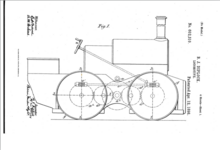
The 1893 Diplock Steam Locomotive was the world'southward commencement 4WD land vehicle.
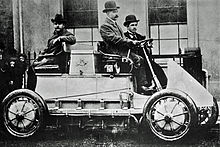
The Lohner-Porsche Mixte Hybrid was both the world'southward commencement hybrid vehicle, and the outset four-wheel drive without a steam engine.

The 1903 Spyker threescore-HP was the world's first 4WD that was direct powered by an internal combustion engine, and the kickoff 4WD race-car.
Late 1800s [edit]
In 1893, before the establishment of the modern automotive manufacture in Britain, English engineer Bramah Joseph Diplock patented a 4-bicycle bulldoze system[13] for a steam-powered traction engine, including four-wheel steering and three differentials, which was afterwards congenital. The development as well incorporated Bramah's Pedrail bike organisation in what was one of the first four-wheel drive automobiles to display an intentional ability to travel on challenging route surfaces. It stemmed from Bramagh's previous idea of developing an engine that would reduce the corporeality of impairment to public roads.
Ferdinand Porsche designed and built a 4-wheel-driven electric vehicle for the k. u. k. Hofwagenfabrik Ludwig Lohner & Co. in Vienna in 1899, presented to the public during the 1900 World Exhibition in Paris. The vehicle was a serial hybrid car that used an electrical hub motor at each bicycle, powered by batteries, which were in plough charged by a gasoline-engine generator.[14] [15] It was clumsily heavy, and due to its unusual status, the so-called Lohner-Porsche is non frequently given its credit as the first four-bicycle driven car.
1900s–1920s [edit]
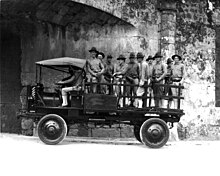
The Jeffery / Nash Quads were the first 4WD vehicles produced in 5-figure numbers (1913–1928).
The earth'due south first four-wheel-drive car straight powered by an internal-combustion engine, and the first with a front end-engine, four-bike-drive layout, was the Dutch Spyker 60 H.P., Commissioned for the Paris to Madrid race of 1903, it was presented that year by brothers Jacobus and Hendrik-Jan Spijker of Amsterdam.[16] [17] The ii-seat sports car featured permanent four-bicycle drive and was also the first car equipped with a six-cylinder engine, also as iv-cycle braking. Later used as a loma-climb racer, it is now an showroom in the Louwman Museum (the former Nationaal Automobiel Museum) in the Hague, the Netherlands.[18]
Designs for four-wheel drive in America offset came from the Twyford Motor Motorcar Company.
The Reynolds-Alberta Museum has a 4-wheel-bulldoze vehicle, named "Michigan", from 1905 in unrestored storage.
The first 4-bicycle-drive vehicles to go into mass product were built by (what became) the American Iv Wheel Drive Car Visitor (FWD) of Wisconsin, founded in 1908. [19] (not to be confused with the term "FWD" as an acronym for front-wheel-drive)
Forth with the 1 1⁄two - and 2-ton Nash Quad (run into below), the three-ton FWD Model B became a standard military four-wheel-drive truck for the U.South. Army in Earth State of war I. Some sixteen,000 FWD Model B trucks were built for the British and American armies during Earth War I – nearly half by FWD and the rest by other licensed manufacturers. Only about 20% of the trucks congenital were iv-wheel drives, merely the 4x4s were more often on the front lines.[20] [21]
About 11,500 of the Jeffery / Nash Quad trucks were built for like utilise between 1913 and 1919. The Quad not only came with 4-wheel-drive and four-bicycle brakes, but as well featured iv-cycle steering.[21] The Quad was 1 of the first successful four-wheel drive vehicles ever to exist made, and its product continued for 15 years with a total of 41,674 units made past 1928.[22]
Daimler-Benz as well has a history in four-wheel drive. Afterwards the Daimler Motoren Gesellschaft had built a four-wheel driven vehicle called Dernburg-Wagen, likewise equipped with four-wheel steering, in 1907, that was used by German colonial civil retainer, Bernhard Dernburg, in Namibia; Mercedes and BMW, in 1926, introduced some rather sophisticated four-wheel drives, the G1, the G4, and G4 following. Mercedes and BMW developed this farther in 1937.
1930s [edit]
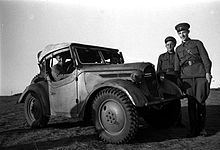
The 1936–1944 Kurogane Blazon 95 scout motorcar (Japan)
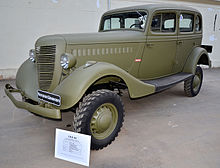
The 1938–1945 GAZ-61 four-cycle drive phaeton (Russia)

1940 GAZ-64 jeep-like car (Russia)
The American Marmon-Herrington Company was founded in 1931 to serve a growing market for moderately priced 4-bike drive vehicles. Marmon-Herrington specialized in converting Ford trucks to four-bicycle drive and got off to a successful start by procuring contracts for war machine and commercial aircraft refueling trucks, four×iv chassis for towing light weaponry, and an order from the Iraqi Pipeline Company for what were the largest trucks built at the time.[23]
The early Marmon-Herringtons proved to be the exception to the rule — 4WD cars and trucks adult in the 1930s were mainly built for governments, with (futurity) warfare applications in mind.
Dodge developed its outset four-wheel drive truck in 1934 — a military 1½ ton designated Grand-39-X-4(The states), of which 796 units were built for the U.Southward. Army in several configurations.[24] Timken supplied front axles and transfer cases, added to militarized a civilian truck. The Timken transfer instance was the first function-time pattern,[25] that immune the driver to engage or disengage four-cycle bulldoze using a lever inside the cab.[26] [27] In spite of the limited 1930s U.Southward. armed services budgets, the '34 truck was liked well-enough that a more mod 1½ ton truck was adult, and i,700 RF-40-10-4(United states) trucks were produced in 1938, and 292 TF-40-X-4(U.s.a.) in 1939.[28] [24]
Starting in 1936, Japanese visitor Tokyu Kurogane Kogyo congenital roughly 4,700 4-wheel bulldoze roadsters, called the Kurogane Type 95 reconnaissance motorcar, used by the Majestic Japanese Army from 1937 until 1944, during the Second Sino-Japanese War. 3 different bodystyles were manufactured – a two-door roadster, a two-door pickup truck, and a iv-door phaeton, all equipped with a transfer case that engaged the front wheels, powered by a 1.iii-litre, 2-cylinder, air-cooled OHV V-twin engine.[29]
The 1937 Mercedes-Benz G5 and BMW 325 four×iv featured full-time iv-cycle drive, four-wheel steering, three locking differentials, and fully independent suspension. They were produced because of a government need for a four-bike-bulldoze omnibus. The modern Chiliad-series/Wolf such as the G500 and G55 AMG nonetheless feature some of the attributes, with the exception of fully independent suspension, since it can compromise footing clearance. The Unimog is too a result of Mercedes 4x4 engineering.
The first Russian-produced iv-wheel drive vehicle, besides in part for civilian utilize, was the GAZ-61, developed in the Soviet Marriage in 1938. "Noncombatant use" may exist a bit of a misnomer, as most, if not all, were used past the Soviet government and military machine (every bit command cars), just the GAZ-61-73 version is the first four-wheel drive vehicle with a normal closed sedan torso. Elements of the chassis were used in subsequent military vehicles such as the 1940 GAZ-64 and the 1943 GAZ-67, as well as the postwar GAZ-69, and the properly civilian GAZ-One thousand-72, based on the rear-wheel drive GAZ-20 "Victory" and built from 1955 to 1958. Soviet civilian life did not allow the proliferation of civilian products such as the Jeep in North America, but through the 1960s, the technology of Soviet 4×4 vehicles stayed on par with British, German language, and American models, even exceeding it in some aspects, and for military purposes just as actively developed, produced, and used.
World War 2 – a spring in AWD proliferation [edit]

The 1940–1945 Willys U.Southward. Jeep
Until "become-anywhere" vehicles were needed for the armed services on a large scale, four-wheel drive and all-bike bulldoze vehicles had not found their place. The World War II Jeep, originally developed by American Runted, but mass-produced by Willys and Ford, became the best-known four-wheel bulldoze vehicle in the globe during the state of war.[thirty] The American Dodge WC series and Chevrolet G506 4x4 variants were as well produced by the hundreds of thousands, likewise as the Canadian Military Design trucks, of which 4x4s were by far the nigh prevalent of their diverse driveline configurations. All told, N America built virtually 1+ one⁄2 one thousand thousand 4x4 driven vehicles during the war,[31] [32] [33]
Availability of certain critical components, such transfer cases and especially constant-velocity joints afflicted development. Though non used much on commercial vehicles,[nb ane] all-wheel bulldoze vehicles all needed these; and they would use two or iii times the number of driven axles, meaning more than gears to cut for all the differentials. Produced up to the war by a few specialized firms with limited capacity, from spring 1942, Ford, Dodge, and Chevrolet joined in fabricating these in a quantity more than a 100-fold greater than in 1939.[34]
Although Russia had their ain jeep-similar vehicle (the GAZ-64) upwardly and running in 1940, a year earlier than the American jeep, in the early years of the war, they relied significantly on Lend-Lease vehicles, provided by the western allies. In 1943, they launched a further-adult version: the GAZ-67.
Past contrast, the Axis powers' closest equivalent to the jeep, the VW Kübelwagen, of which merely some 50,000 were built, though being equipped with portal gear hubs, simply had rear-wheel bulldoze.
1945–1960s [edit]


A first-generation Dodge Power Wagon
Willys introduced the model CJ-2A in 1945, the starting time full-production four-bicycle drive vehicle for sale in the general market. Due to the ubiquitous World War II Jeep'southward success, its rugged utilitarianism set the blueprint for many iv-wheel drive vehicles to come.[35] Hot on its heels, Contrivance besides started production of the civilian 4WD Power Railroad vehicle trucks, for the 1946 model twelvemonth. Both the Willys and the Dodge were developed directly from their WW Ii predecessors.
Equally boxy to the Jeep, and also inline-four powered, the Country Rover appeared at the Amsterdam Motor Testify in 1948. Originally conceived as a stop-gap product for the struggling Rover motorcar company, despite chronic underinvestment, it succeeded far better than their passenger cars. Inspired past a Willys MB – the ubiquitous WWII "jeep" – that was frequently run off-route on the farm belonging to chief engineer Maurice Wilks, Land Rover developed the more refined yet still off-route capable luxury 4WD Range Rover in the 1970s.
With the acquisition of the "Jeep" name in 1950, Willys had cornered the brand. Its successor, Kaiser Jeep, introduced a revolutionary 4WD carriage called the Wagoneer in 1963. Not only was it technically innovative, with independent front end suspension and the first automatic manual coupled to 4WD, just also it was equipped and finished every bit a regular rider automobile.[36] In effect, it was the antecedent of the modern SUV. The luxury AMC or Buick V8-powered Super Wagoneer produced from 1966 to 1969 raised the bar fifty-fifty college.
Jensen applied the Formula Ferguson (FF) total-time all-bike-drive system to 318 units of their Jensen FF built from 1966 to 1971, marking the first fourth dimension 4WD was used in a production GT sports automobile.[37] While near 4WD systems split torque evenly, the Jensen dissever torque roughly twoscore% front, sixty% rear by gearing the front and rear at different ratios.
1970s–1990s [edit]
American Motors Corporation (AMC) acquired Kaiser's Jeep Segmentation in 1970 and quickly upgraded and expanded the unabridged line of off-road 4WD vehicles. With its added roadworthiness, the top-range total-sized One thousand Wagoneer continued to compete with traditional luxury cars.[38] Partially hand-congenital, information technology was relatively unchanged during its product through 1991, even afterwards Chrysler'southward buyout of AMC.
Subaru introduced the category-expanding Leone in 1972, an inexpensive compact station carriage with a calorie-free-duty, part-time 4-cycle drive organization that could not be engaged on dry out pavement. In September, AMC introduced Quadra Trac full-time AWD for the 1973 model year Jeep Cherokee and Wagoneer.[39] Due to full-time AWD, which relieved the commuter of getting out to lock hubs and having to manually select betwixt 2WD and 4WD modes, it dominated all other makes in FIA rally competition. Gene Henderson and Ken Pogue won the Press-on-Regardless Rally FIA championship with a Quadra Trac-equipped Jeep in 1972.[xl]

1969 Jensen FF, world's first 4WD in a production GT sports motorcar

A 1987 AWD AMC Eagle wagon, the about popular model in the line

A 1981 AMC Eagle AWD convertible
American Motors introduced the innovative Hawkeye for the 1980 model year.[41] These were the first American mass-production cars to use the complete front-engine, four-wheel drive organization.[42] The AMC Eagle was offered as a sedan, coupe, and station carriage with permanent automatic all-wheel drive passenger models. The new Eagles combined Jeep applied science with an existing and proven AMC passenger automobile platform. They ushered a whole new production category of "sport-utility" or crossover SUV. AMC's Eagles came with the condolement and high-level appointments expected of regular rider models and used the off-road engineering science for an actress margin of safety and traction.[43]
The Eagle'due south thick pasty fluid center differential provided a quiet and smooth transfer of power that was directed proportionally to the axle with the greatest traction. This was a true full-fourth dimension system operating just in four-wheel drive without undue wear on intermission or driveline components. No low range was used in the transfer example. This became the forerunner of the designs that followed from other manufacturers.[44] The auto press at the fourth dimension tested the traction of the Eagles and described it as far superior to the Subaru's and that it could beat many so-called off-route vehicles. Four Wheeler mag concluded that the AMC Hawkeye was "The beginning of a new generation of cars."[45]
The Eagles were popular (peculiarly in the snowbelt), had towing capacity, and came in several equipment levels including sport and luxury trims. Two additional models were added in 1981, the subcompact SX/4 and Kammback. A manual transmission and a forepart axle-disconnect feature were also made available for greater fuel economy. During 1981 and 1982, a unique convertible was added to the line. The Hawkeye'southward monocoque body was reinforced for the conversion and had a steel targa bar with a removable fiberglass roof section.[46] The Eagle station wagon remained in production for one model year afterwards Chrysler acquired AMC in 1987. Total AMC Eagle production was almost 200,000 vehicles.
Audi also introduced a permanently all-wheel-driven route-going car, the Audi Quattro, in 1980. Audi's chassis engineer, Jörg Bensinger, had noticed in wintertime tests in Republic of finland that a vehicle used past the Due west German Army, the Volkswagen Iltis, could beat any high-functioning Audi. He proposed developing a 4-wheel drive car that would likewise be used for rallying to improve Audi'due south conservative image. The Audi quattro system became a feature on product cars.
In 1987, Toyota also developed a car built for contest in rally campaigns.[47] A express number of route-going FIA Homologation Special Vehicle Celica GT-Four (known as Toyota Celica All-Trac Turbo in N America) were produced. The All-Trac system was subsequently available on serial product Toyota Camry, Toyota Corolla, and Toyota Previa models.
Some of the earliest mid-engined iv-wheel drive cars were the diverse road-legal rally cars made for Group B homologation, such every bit the Ford RS200 fabricated from 1984 to 1986. In 1989, niche maker Panther Westwinds created a mid-engined four-bicycle-bulldoze, the Panther Solo two.
2000–present [edit]
In the United states of america, as of late 2013, AWD vehicles comprised 32% of new light vehicle sales, up 5% since 2008.[48] This is in large part due to the popularity of the crossover.[48] Most crossovers offer the popular applied science, in spite of it increasing vehicle price and fuel consumption.[49] Car manufacturers have inundated consumers with marketing proclaiming AWD equally a safety feature, although the reward of AWD over FWD occurs in accelerating, non braking or steering.[50] Tests have shown that though AWD gives improved acceleration in wintery conditions, information technology does not help with braking.[51]
In 2008, Nissan introduced the GT-R featuring a rear-mounted transaxle. The AWD arrangement requires two drive shafts, one main shaft from the engine to the transaxle and differential and a second bulldoze shaft from the transaxle to the front wheels.[52]
Uses [edit]
Route racing [edit]
Spyker is credited with edifice and racing the first four-wheel drive racing car, the Spyker sixty HP in 1903.[53] [17]
Bugatti created a total of 3 four-wheel drive racers, the Type 53, in 1932, but the cars were notorious for having poor handling.
Miller produced the first 4WD motorcar to qualify for the Indianapolis 500, the 1938 Miller Gulf Special.
Ferguson Enquiry Ltd. built the forepart-engined P99 Formula One car that actually won a not-World Title race with Stirling Moss in 1961. In 1968, Team Lotus raced cars in the Indy 500 and three years later in Formula 1 with the Lotus 56, that had both turbine engines and 4WD, likewise as the 1969 4WD-Lotus 63 that had the standard 3-litre V8 Ford Cosworth engine. Matra too raced a similar MS84, and McLaren entered their M9A in the British Grand Prix, while engine manufacturers Ford-Cosworth produced their own version, which was tested but never raced. All these F1 cars were considered inferior to their RWD counterparts, every bit the advent of aerodynamic downforce meant that acceptable traction could be obtained in a lighter and more mechanically efficient manner, and the idea was discontinued, though Lotus tried repeatedly.
Nissan and Audi had success with all-wheel drive in road racing with the former's advent of the Nissan Skyline GT-R in 1989. And so successful was the machine that it dominated the Japanese excursion for the first years of production, going on to bigger and more impressive wins in Australia before weight penalties eventually levied a de facto ban on the car. Most controversial was the win pulled off at the 1990 Macau Grand Prix, where the machine led from start to finish. Audi's dominance in the Trans-Am Serial in 1988 was as controversial, as it led to a weight penalty midseason and to a dominion revision banning all AWD cars; its dominance in Super Touring eventually led to a FIA ban on AWD organisation in 1998.
New 2022 24 Hours of Le Mans regulations may revive AWD/4WD in route racing, though such systems are but allowed in new hybrid-powered Le Mans prototypes.[54] One case is the Audi R18 e-tron quattro (winner of 2022 race, the offset hybrid/4WD to win Le Mans), using an electric motor in the front beam with the gasoline engine in the rear.[55]
In heavy trucks [edit]
Medium-duty and heavy-duty trucks accept recently adopted 4×four drivetrains; 4×4 medium-duty trucks became common after Ford began selling Ford Super Duty trucks. These trucks shared many parts between the lite-duty and medium-duty, reducing product costs. The Dana 60 front end beam is used on both medium- and calorie-free-duty Super Duty trucks. Furthermore, the Big Three share/shared parts between the companies, reducing costs. The Dana S 110 is currently being used for the rear bulldoze, nether Ford and Ram'due south medium-duty trucks. The Dana 110 was also used on the General Motors 4×4s. Ram Trucks began selling medium-duty trucks, 4×four and iv×2, in 2008. General Motors sold a four×4 for model years 2005–2009.
-
GM 4×4 medium-duty trucks
-
Heavy-duty International Workstar
-

Ford medium-duty 4×iv bulldoze railroad train
In structure equipment [edit]
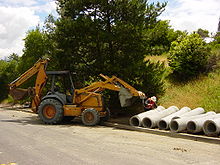
Volvo introduced the Model 646 four-wheel drive backhoe loader in 1977.[56] Example Corporation followed adapt in the U.S. in 1987.[ citation needed ]
Terminology [edit]
In engineering science terms, "four-bicycle drive" designates a vehicle with ability delivered to four bike ends spread over at least two axles. The term "4×4" (pronounced four by four) was in use to describe North American war machine four-bike bulldoze vehicles every bit early as the 1940s,[57] with the first number indicating the number of wheel ends on a vehicle and the 2d indicating the number of driven wheels.
Trucks with dual tires on the rear axle and two driven axles are designated as four×4s despite having six wheels, because the paired rear wheels behave as a unmarried wheel for traction and classification purposes. True half dozen×six vehicles, which accept three powered axles, are classified as half dozen×6s regardless of how many wheels they take. Examples of these with two rear, one front axle are the half dozen-wheeled Pinzgauer, which is popular with defence forces around the globe, and x-wheeled GMC CCKW made famous by the U.S. Regular army in World War II.
Four-wheeler is a related term applying to all-terrain vehicles, and not to exist dislocated with four-bike drive. The "four" in the instance referring to the vehicle having four wheels, not necessarily all driven.
Unusual systems [edit]
Prompted by a perceived need for a simple, inexpensive all-terrain vehicle for oil exploration in Northward Africa, French motor manufacturer Citroën adult the 2CV Sahara in 1958. Unlike other 4×4 vehicles, which use a conventional transfer case to drive the forepart and rear axles, the Sahara had ii engines, each independently driving a separate beam, with the rear engine facing backwards. The two throttles, clutches, and gear-modify mechanisms could exist linked, so the two 12 hp (9 kW) 425 cc (26 cu in) engines could run together, or they could be split and the car driven solely by either engine. Combined with twin fuel tanks and twin batteries (which could exist ready to run either or both engines), the redundancy of two separate bulldoze trains meant that they could make information technology back to civilisation even subsequently major mechanical failures. Only effectually 700 of these cars were built, and only 27 are known to exist today.[58]
BMC experimented with a twin-engined Mini Moke (dubbed the "Twini Moke") in the mid-1960s, but never put information technology into production. This made advantage of the Mini's 'power pack' layout, with a transverse engine and the gearbox in the engine sump. Simply past fitting a second engine/gearbox unit across the rear, a rudimentary four×four system could be produced. Early prototypes had separate gear levers and clutch systems for each engine. Later versions sent for evaluation by the British Army had more user-friendly linked systems.
In 1965, A. J. Thousand. Chadwick patented a 4WD system, GB 1113068, that used hemispherical wheels for an all-terrain vehicle. Xx years later, B. T. Due east. Warne, patented, GB 2172558, an comeback on Chadwick'south design that did not use differential gear assemblies. By using nearly-spherical wheels with the provision to tilt and plough each bike co-ordinatively, the driven wheels maintain abiding traction. Furthermore, all driven wheels steer, and as pairing of wheels is not necessary, vehicles with an odd number of wheels are possible without affecting the system's integrity. Progressive deceleration is made possible by dynamically irresolute the forepart-to-rear effective wheel diameter ratios.
Suzuki Motors introduced the Suzuki Escudo Pikes Peak Edition in 1996. Earlier Suzuki versions were twin-engined; from 1996 on, the engine is a twin-turbocharged two.0-Fifty V6, mated to a sequential 6-speed manual manual.
Nissan Motors has developed a system called E-4WD, designed for cars that are normally front-wheel bulldoze; however, the rear wheels are powered by electric motors. This system was introduced in some variants of the Nissan Cube and Tiida. (This is similar to the system used on the Ford Escape Hybrid AWD.[59])
Chrysler's Jeep Division debuted the twin-engined, 670 hp (500 kW) Jeep Hurricane concept at the 2005 North American International Machine Show in Detroit. This vehicle has a unique "crab crawl" capability, which allows information technology to rotate 360° in place. This is accomplished past driving the left wheels as a pair and the right wheels equally a pair, as opposed to driving the front end and rear pairs. A cardinal gearbox allows one side to bulldoze in the reverse management from the other. It also has dual Hemi V8s.
Some hybrid vehicles such equally the Lexus RX400h provide power to an AWD arrangement through a pair of electrical motors, one to the front wheels and one to the rear. In the case of the AWD model version of the Lexus RX400h (and its Toyota-branded counterpart, the Harrier hybrid), the front end wheels tin can also receive drive ability straight from the vehicle's gasoline engine, too as via the electric motors, whereas the rear wheels derive power merely from the second electric motor. Transfer of power is managed automatically by internal electronics based on traction conditions and need, making this an all-cycle-drive arrangement.
The 4RM system used in the Ferrari FF in 2022 is unique in that it has a rear transaxle with a secondary front transaxle connected directly to the engine. The auto operates primarily every bit a rear-wheel drive vehicle. Clutches in the front transaxle engage when the rear wheels sideslip. Drive to the front wheels is transmitted through ii infinitely variable clutch packs that are allowed to 'slip' to requite the required road wheel speeds. The front end transaxle has three gears, two forward, and reverse. The two forward gears of the front transmission match the lower four forward gears of the rear transmission. It is not used in higher gears. The connection between this gearbox and each front bicycle is via contained Haldex-blazon clutches, without a differential. Due to the divergence in ratios, the clutches continually slip and only transmit, at near, twenty% of the engine's torque.[60]
Systems past blueprint type [edit]
Center differential with mechanical lock [edit]
- Alfa Romeo 164 Q4 (key viscous coupling, epicyclic unit of measurement and Torsen rear differential)
- Alfa Romeo 155 Q4 (fundamental epicyclic unit, Ferguson gummy coupling and Torsen rear differential)
- AMC Eagle (central mucilaginous coupling)
- Audi – Quattro Coupé, 80, 90, 100 & 200 (locking center and rear differentials) – upward to 1987
- Audi Q7 -double pinion l/l with lockup clutch pack
- BMW 3 series and 5 series in the 1980s – planetary center differential with a 37–63 (front end-back) torque separate and viscous lock (besides in rear differential but not front end differential)
- Chevrolet Rounded-Line One thousand Fleetside, One thousand Stepside, Thousand Blazer, and K Suburban – permanent four-wheel drive (1973–1979) two-speed New Process 203 transfer case, heart differential with 50:fifty torque divide and lock. An Eaton Automatic Differential Lock was optional for the rear hypoid differential.
- Ford Escort RS (RS 2000 16v 4×iv models and RS Cosworth), Sierra Cosworth, Sierra and Granada iv×4 models,
- Dodge Power Wagon – permanent four-cycle bulldoze (1974–1979) two-speed New Process 203 transfer case, center differential with 50:l torque split and lock.
- Ford Trek (1997–present) and Expedition EL/Max (2007–nowadays) – automated ControlTrac iv-bike drive with two-speed dual range BorgWarner transfer case and intelligent locking center multi-disc differential
- Ford Explorer (1995–2010) – automatic ControlTrac four-wheel drive with two-speed dual range BorgWarner transfer case and intelligent locking center multi-disc differential
- Ford F-Serial – permanent four-wheel drive (1974–1979) two-speed New Process 203 transfer instance, centre differential with fifty:50 torque split and lock.
- GMC Rounded-Line Grand Wideside, K Fenderside, K Jimmy, and K Suburban – permanent four-wheel drive (1973–1979) two-speed New Process 203 transfer case, center planetary differential with 50:fifty torque divide and lock. An Eaton Automatic Differential Lock was optional for the rear hypoid differential.
- H1 & Humvee NVG 242HD AMG open up middle differential, locked center differential, Neutral, low range locked. Likewise Torsen1 differential at the front and rear beam, The H1 moved to Torsen2 when ABS was added. The H1 Alpha had optional locking differentials in place of torsens.
- Hummer H2, H3 xl/60 planetary with lock
- Jeep Grand Cherokee, Commander (except models equipped with Quadra-Trac I)
- Jeep Liberty, Jeep Cherokee (XJ), Dodge Durango (Select-Trac) – NV 242 transfer case- rear drive, open center differential, locked heart differential, Neutral, low range
- Full size Jeeps with Borg Warner QuadraTrac: limited-sideslip center differential, l/50 locked heart differential. Depression range could be used in locked or unlocked fashion, allowing for use of the low range on pavement.
- Land Rover Defender (and Series III V8 models)
- Country Rover Discovery/LR3
- State Rover Freelander
- Lada Niva (VAZ-2121) – full-time 4WD using open middle differential. Transfer example with high/low range and manual central diff lock. Low range selectable in locked or unlocked mode, allowing use on pavement.
- Lexus RX300 -viscid coupling beyond the otherwise open center differential.
- Lincoln Navigator (1998–2006) – automatic ControlTrac iv-wheel drive with two-speed dual range BorgWarner transfer instance and intelligent locking center multi-disc differential
- Navigator and Navigator L (2007–present) use a one-speed single range transfer case, no reduction gearing
- Mercedes-Benz Unimog (locking centre and rear with up to x low range gears).
- Mercedes-Benz G-Grade (locking center and lockers on both front- and rear axle)
- Mercedes-Benz GL-Class – 4Matic all-bike-bulldoze organization
- Mitsubishi Pajero (besides known as Montero or Shogun)
- Porsche Cayenne – 38/62 planetary with lockup clutch pack
- Range Rover Classic 1970–1995 all total-fourth dimension 4WD either plate LSD, manual lock or Ferguson pasty center differential.
- Range Rover second Gen. 1994–2002 full-time 4WD Ferguson gluey heart differential
- Suzuki G Vitara/Escudo (2005 and later models, excepting the XL-7) -full-time 4WD using express-slip center differential, off-route 4WD with selectable centre differential lock and depression range transfer instance four mode (4h, 4h lock, 4l due north), traction command and electronic stability command
- Subaru – manual transmissions come up with 50/fifty viscous-type middle differential; performance models include a planetary differential with reckoner-regulated lockup; automatic transmission models have an electronically controlled variable transfer clutch.
- Toyota Land Cruiser
- Toyota Sequoia (Multi-fashion)
- Volkswagen Touareg -double pinion 50/50 with lockup clutch pack
Torsen middle differential [edit]
- Alfa Romeo Q4s – with (Torsen T-three):
- 156 Crosswagon and Sportwagon
- 159
- Brera, Spider
- Audis with quattro – various iterations of Torsen, the T-three starting from the 2007 B7 RS4
- 80, 90 & Coupé (Typ 89)
- 100 & 200
- A4, S4, RS4
- A5 & S5
- A6, S6, RS6
- A8, S8
- Q5, Q7
- Bentley Continental GT, Bentley Continental Flying Spur (2005) initially Torsen T-ii, current have T-3
- Chevrolet Trailblazer SS Torsen T-3
- Lexus GX470, Toyota Land Cruiser Prado 120 Torsen T-3
- Range Rover tertiary Gen. 2002–2009
- Toyota 4Runner (Simply 2003-2009 model and 2010+ Express V6 model) Torsen T-iii with lock
- Toyota FJ Cruiser (only manual models) Torsen T-3 with lock
- Toyota Hilux Surf Torsen T-3 with lock
- Toyota Land Cruiser 200/2008/V8 Torsen T-3 with lock
- Toyota Sequoia (only 2005–07 Models)
- Volkswagen Passenger Cars with 4motion:
- Volkswagen Passat Torsen T-ii (B5.5 model, not latest B6 model with transverse engine)
- Volkswagen Phaeton Torsen T-2
Non-locking center differential [edit]
- BMW 3-series and X5 betwixt 2001 and xDrive – planetary eye differential with permanent 38–62 (front-back) torque split #
- Cadillac Escalade, STS AWD, SRX AWD (The get-go two generations had a gluey clutch on the middle differential) #
- Chrysler 300C AWD#
- Dodge Ramcharger 1974–1981 – NP203 FullTime 4WD Transfer Case
- Dodge Magnum, Charger AWD #
- GMC Yukon Denali, Twoscore Denali, Sierra Denali #
- Mercedes 4MATIC cars, R course, and ML grade (notation some MLs had low range) #
- Plymouth Trail Duster 1974–1981 – NP203 FullTime 4WD Transfer Case
- Toyota Highlander #
- Toyota Sienna AWD (−2010 simply) #
The above systems ending with "#" role past selectively using the traction command organisation (via ABS) to brake a slipping cycle.
Multiple-clutch systems [edit]
- Acura RL, RDX (SH-AWD) Right and left axle shaft
- Acura MDX SH-AWD & VTM4
- Ford Explorer – Ford's total-time shift-on-the-fly Intelligent 4WD System (I-4WD) on the 2022 Explorer with Terrain Direction Arrangement and RSC (Gyre Stability Command), Curve Control functionality, HDC (Hill Descent Control) and HAA (Hill Rising Assist).[61] [62]
- Honda Ridgeline
- Honda Pilot
- Infiniti FX (ATTESA E-TS)
- Mercedes-Benz 1st generation 4MATIC (normally rear-drive, automatic clutch in transfer case engages 4WD on demand)
- Mitsubishi GTO MR/3000GT VR-4
- Mitsubishi Lancer Evolution Series South-AWC
- 2010 Mitsubishi Outlander GT S-AWC
- Mitsubishi Outlander (2003–2006) contained front and rear beam coupling, and Active Center Differential.
- Nissan GT-R (ATTESA E-TS)
- Nissan Skyline GT-R (ATTESA E-TS and ATTESA Due east-TS-PRO) front beam coupling, rear differential locking
- Nissan Skyline GTS4 (ATTESA E-TS)
- Nissan A31 Cefiro SE4 (ATTESA E-TS)
- Porsche 959 PSK front end beam coupling, rear differential locking
- Saab 9-3, Saab 9-v, Saab 9-4X (Saab XWD)
Multi-plate clutch coupling [edit]
- Audi A3 quattro, Audi S3, Audi TT quattro, Audi R8 (with Haldex Traction)
- BMW xDrive: latest 3 Serial, latest 5 serial, X3, latest X5 series
- Chevrolet Equinox (GMPCA)
- Chrysler Pacifica (BorgWarner ITM3e) (on 2007 model)
- Dodge Nitro (Quadra-Trac 1)
- Dodge Quotient
- Ford: Escape, Freestyle, Border, Fusion, Five Hundred (Freestyle, FiveHundred Haldex Traction based) (Escape Control Trac II, based)
- Honda CR-V, HR-V, Element
- Hyundai Santa Fe, Hyundai Tucson Borg-Warner ITM 3e magnetic multi-plate clutch coupling
- Hyundai Veracruz IMJ magnetic multi-plate clutch coupling
- Infiniti: G35x, M35x
- Jeep Compass (Freedom Drive)
- Jeep M Cherokee and SRT8 NVG 249, 247
- Country Rover Freelander ii/LR2 (as well Haldex Traction)[63]
- Lamborghini: AWD variants VT series (glutinous traction)
- Lincoln: MKS, MKZ
- Mazdaspeed6 (a power takeoff unit linked to clutch pack with torque sensitive rear differential)
- Mazda: Tribute, CX-7, CX-9 (tribute Control Trac 2, based)
- Mercury: Milan, Montego, Mariner (Montego Haldex Traction-based)
- Mitsubishi Outlander (electric current generation)
- Nissan Murano automated with manual lockup switch
- Porsche 911 AWD variants (a version of BorgWarner ITM3e) — excluding the 964-series Porsche 911 Carrera 4 31/69 planetary center differential
- Pontiac Torrent (GMPCA)
- Subaru low powered automatic transmission models
- Subaru Legacy, Outback, Impreza, Forester, Tribeca automatic transmission models: mechanical front drive, clutch coupled rear axle
- Suzuki: SX4, XL7, Aerio, Swift/Cultus based Subaru Justy. (viscous clutch)
- Toyota RAV4 – from 2005 (third generation merely)
- Toyota Sienna AWD (2011 and newer only)
- Volkswagen Golf 4motion, Volkswagen Jetta 4motion, Volkswagen Tiguan 4motion, Volkswagen Passat (B6) 4motion (initially gluey coupling, later with Haldex Traction)
- Volvo: S40, S60, S80, V50, V70, XC70, XC90 (Visco system until 2003; then all Haldex Traction-based)
Note: the higher up all function like 2WD when the multi-plate clutch coupling is not engaged (with exception of Subaru models), and like 4WD loftier-range in a office-time 4WD system when the clutch is engaged (commonly by calculator although some permit manual control). Some in this category have varying degrees of control in the torque distribution between forepart and rear by allowing some of the clutches in a multi-plate clutch coupling to engage and skid varying amounts. An example of a system similar this is the BorgWarner i-Trac(TM) system. Note: the Haldex Traction-based machine list was created from the list on Haldex Traction corporate website: Haldex Cars. A version of the BorgWarner ITM3e system is used on 2006 and upwards Porsche 911TT'south. The Borg-Warner ITM 3e is as well used in the 2006-now Hyundai Santa Fe and the Hyundai Tucson. In the Hyundais, the ITM 3e acts similar a full-time AWD with 95:five normal torque split. In extreme atmospheric condition, the system can be locked in a l:50 split via the 4WD LOCK button.
Role-fourth dimension [edit]
These are vehicles that accept no center differential. Since there is no center differential to allow for speed differences between the front and rear wheels when turning, a small corporeality of tire slippage must occur during turns. When used on slick surfaces, this is non a problem, but when turning on dry pavement, the tires grip, then are forced to slip, so grip again, then on, until the plough is completed. This causes the vehicle to exhibit a 'hopping' or 'binding' awareness. Using an engaged part-time 4WD system on a hard surface is not recommended, equally impairment to the drive-line somewhen occurs. Part-time transfer cases are the industry standard transfer case for the 4x4 truck market. Any other transfer instance tin be considered more robust, all the same more moving parts and complication tin can, sometimes, make other transfer cases less durable.
See besides [edit]
- 4WS
- Dune bashing
- Four-wheel drive in Formula Ane
- Limited slip differential
- Off-road vehicle
- Rock crawling
- Sport utility vehicle
- Transfer case
- Driveline windup
Footnotes [edit]
- ^ Front end-wheel drive vehicles had not notwithstanding become common at that time
References [edit]
- ^ a b Mohan, Sankar (12 June 2000). "All – Wheel Drive / Four – Wheel Drive Systems and Strategies" (PDF). Seoul 2000 FISITA World Automotive Congres.
- ^ Andreev, Alexandr F.; Kabanau, Viachaslau; Vantsevich, Vladimir (2010). Driveline Systems of Footing Vehicles: Theory and Design. CRC Printing. p. 34. ISBN9781439817285.
- ^ Dykes, Alex. "Alphabet Soup: four×four vs 4WD vs AWD Where'southward the Differential?". thetruthaboutcars.com . Retrieved 18 December 2015.
- ^ a b Surface Vehicle Recommended Practice – J1952 – All-Wheel Drive System Classification, SAE International, October 2013 .
- ^ Walczak, Jim. "4WD vs 2WD: The Differences Between 4×4 And iv×2". about.com . Retrieved seven August 2010.
- ^ Hyde, Charles K. (2013). Arsenal of Democracy: The American Automobile Industry in World War Two. Wayne Land University Press. pp. 147–148. ISBN9780814339527.
- ^ a b Collard, Chris. "2WD vs AWD vs 4WD". ConsumerReports.com. Consumer Reports Mag. Retrieved fifteen Dec 2015.
- ^ Williams, Mark. "4WD vs AWD: What'due south the Diff". MotorTrend.com. Motor Trend Magazine. Retrieved 15 Dec 2015.
- ^ Allisons.org Automotive History [1]"1929: AEC started to build AWD trucks in conjunction with FWD (UK)"
- ^ Meyer, Donald East. (March 2009). "The First Century of GMC Truck History" (PDF). gmheritagecenter.com . Retrieved fifteen September 2021.
- ^ a b Sheppard, Tom (1 September 2005). "Jeep Grand Cherokee 4WD Organisation Breakthrough – 4x... For?". Four Wheeler Network. Retrieved 27 May 2014.
- ^ Davies, Alex (10 October 2014). "The Model D Is Tesla'south Near Powerful Motorcar Ever, Plus Autopilot". Wired.com . Retrieved 11 October 2014.
Musk said the added efficiency is thanks to the electronic system that will shift power between the front and rear motors from one millisecond to the adjacent, so each is ever operating at its nigh efficient point
- ^ Diplock 4WD Locomotive Patent
- ^ "History of Hybrid Vehicles". HybridCars.com. 27 March 2006. Archived from the original on iv September 2009. Retrieved 25 October 2011. Encounter year 1898.
- ^ "Lohner-Porsche Mixte Voiturette". Ultimate Car Page. 19 Nov 2007. Retrieved 25 October 2011.
- ^ History of 4WD Sport – OF4WD
- ^ a b "1903 Spyker 60 HP". Retrieved half-dozen May 2011.
- ^ Spyker lx-hp Four-wheel Bulldoze Racing Car – Louwman Museum
- ^ The Badger and F.W.D. Four-Wheel Drive Automobiles – The Old Motor
- ^ Allen, Jim (8 May 2016). "FWD Seagrave Model B: 1 of the First Successful 4x4 Trucks". Fourwheeler Network. Extreme Ventures. Retrieved fifteen February 2018.
- ^ a b Eckermann, Erik (2001). World history of the automobile. Society of Automotive Engineers. p. 76. ISBN978-0-7680-0800-5 . Retrieved 21 January 2013.
- ^ Redgap, Curtis; Watson, Bill (2010). "The Jefferys Quad and Nash Quad — 4x4 Antecedent to the Willys Jeep". Allpar. Retrieved 6 December 2014.
- ^ "History of Innovation". Marmon-Herrington. 2009. Retrieved 22 May 2018.
- ^ a b 1943 Dodge WC-51 Weapons Carrier, Power & Glory – FourWheeler.com
- ^ Allen, Jim (2009). Four-Wheeler's Bible. MotorBooks International. p. 21. ISBN9781616730888.
- ^ DeLorenzo, Matt (15 February 2014). Dodge 100 Years. MotorBooks International. p. 55. ISBN9781627880848.
- ^ 1946–1948 Contrivance Power Railroad vehicle – HowStuffWorks
- ^ "Series Number Guide". T137.com. Archived from the original on 18 July 2016. Retrieved fifteen February 2018.
- ^ The world's first mass-produced meaty 4WD car, restored – Japanese Nostalgic Auto
- ^ Editors of Air Force Journal of Logistics (2000). The Logistics of War – a historical perspective. The Air Strength Logistics Management Agency. p. 282. ISBN9781428993785 . Retrieved 21 January 2013.
It became a famous vehicle effectually the earth and is mentioned in a majority of the histories.
{{cite volume}}: CS1 maint: uses authors parameter (link) - ^ Hyde, Charles K. (2013). Arsenal of Democracy: The American Motorcar Industry in Globe State of war II . Wayne State University Printing. pp. 152–153. ISBN9780814339527.
- ^ Taylor, Peter Shawn (19 April 2016). "The Trucks that Beat Hitler". National Post. Postmedia Network. Retrieved 9 May 2018.
- ^ Winnington-Brawl, Geoff (ten March 2002). "CMP Softskin Trucks". Maple Foliage Up.net . Retrieved 9 May 2018.
- ^ Thomson, Harry C.; Mayo, Lida (2003). The Ordnance Section: procurement and supply. Washington, D.C.: Middle of Armed services History, U.South. Army (Originally published: 1960, Washington, D.C., Part of the Chief of Armed forces History, Dept. of the Army). p. 273/274.
- ^ Nunney, Chiliad J J (2012). Light and Heavy Vehicle Technology (4th ed.). Routledge. p. 431. ISBN9780750680370 . Retrieved 21 Jan 2013.
- ^ Foster, Patrick (January 2008). "1963 Jeep Wagoneer – Landmark Vehicle". 4 Wheel Drive & Sport Utility Mag . Retrieved 21 January 2013.
- ^ Machine Editors of Consumer Guide (25 July 2007). "1966–1971 Jensen FF". howstuffworks.com . Retrieved seven August 2010.
- ^ Auto Editors of Consumer Guide (29 August 2007). "1978–1979 Jeep Wagoneer Limited". HowStuffWorks.com . Retrieved 5 January 2011.
- ^ Auto Editors of Consumer Guide (29 Baronial 2007). "1967–1977 Jeep Wagoneer". howstuffworks.com . Retrieved seven Baronial 2010.
- ^ Calvin, Jean (1974). Rallying to win: a complete guide to North American rallying. Westward.W. Norton. p. 150. ISBN978-0-87880-017-9 . Retrieved 5 Jan 2011.
- ^ Sherman, Don (Feb 2001). "All-Wheel-Drive Revisited: AMC's 1980 Eagle pioneered the cross-over SUV". Automotive Industries. Archived from the original on 1 May 2013. Retrieved 21 Jan 2013.
- ^ Rettie, John (Baronial 1987). "Four-Wheeling Into Your Future". Popular Mechanics. 164 (eight): 58. Retrieved 5 January 2011.
- ^ Sass, Rob (9 March 2008). "A Breed of 4-by-4 Hatched on the Fly". The New York Times . Retrieved 21 Jan 2013.
- ^ Padgett, Martin (2004). Hummer. Zenith. p. 26. ISBN978-0-7603-1863-8 . Retrieved 21 Jan 2013.
- ^ Foster, Patrick R. "1980–88 AMC Hawkeye 4wd". Autoweek (archived at amxfiles). Archived from the original on 30 April 2008. Retrieved 21 Jan 2013.
- ^ Consumer's Guide, ed. (2005). History of the American Auto. Publications International. p. 532. ISBN978-0-7853-9874-5.
- ^ "Celica All Trac and Gt-Four FAQ". Alltrac.internet . Retrieved vii Baronial 2010.
- ^ a b Kranz, Rick. "All-Wheel-Drive Vehicles Grow in Popularity With Car Shoppers". Edmunds . Retrieved 3 August 2017.
- ^ Shunk, Chris. "30-percent of new automobile sales will be AWD by 2015". autoblog . Retrieved iii Baronial 2017.
- ^ "Practise You Really Need AWD in the Snow?". Consumer Reports . Retrieved 3 Baronial 2017.
- ^ Peter, Cheney. "The myth of all-bike-drive and why it tin can exist a deadly trap". The Gobe and Post . Retrieved iii August 2017.
- ^ Loh, Edward (December 2007). "First Wait: 2008 Nissan GT-R". Retrieved 5 January 2011.
- ^ Henry, Allan (1975). The 4-Wheel Drives: Racing's Formula for Failure?. Macmillan.
- ^ "The 2022 Le Mans 24 Hours Regulations". lemans.org. 6 October 2010. Archived from the original on 13 June 2010. Retrieved 21 January 2013.
- ^ "Hybrid Tech Dominates The 24 Hours Of Le Mans Endurance Race [VIDEO]". Autoblog.com.
- ^ "Volvo BM 646 Backhoe/Loader" (PDF). Volvo AB. Archived from the original (PDF) on 22 December 2015.
- ^ "Instruction Book: Driving, Maintenance, Repair. Department of National Defence, Canada". bcoy1cpb.pacdat.net. 1940. Archived from the original on 21 March 2012. Retrieved 21 January 2013.
- ^ Melissen, Wouter (i Dec 2004). "Citroën 2CV Sahara". Ultimatecarpage.com . Retrieved 21 January 2013.
- ^ "2009 Ford Escape Hybrid Review and Specs". Edmunds.com. Archived from the original on one March 2009. Retrieved 1 August 2009.
- ^ Horrell, Paul (25 January 2011). "Ferrari FF The inside scoop on Ferrari's new FF". Topgear.com . Retrieved 6 May 2011.
- ^ Abuelsamid, Sam (26 July 2010). "2011 Ford Explorer puts four-cylinder EcoBoost engine in a higher place V6 in pecking club". Autoblog.com . Retrieved 26 September 2010.
- ^ "Ford – Cars, SUVs, Trucks & Crossovers". FordVehicles.com (in Castilian). Archived from the original on 30 September 2010. Retrieved 26 September 2010.
- ^ Co-ordinate to Car and Commuter Vol52 No 8, February 2007, page 110
Source: https://en.wikipedia.org/wiki/Four-wheel_drive

Post a Comment for "Can You Go in Reverse in 4 Wheel Drive"